Complaints
Complaints
Just the Facts, Not Legal Arguments

Complaints in General
The complaint is the most important document in a lawsuit.
It's where the battle begins.
It's where you say what you plan to prove!

Every civil case begins with a complaint or petition (explained later). Criminal cases begin with a charging instrument that is similar to a complaint in that it alleges what the prosecutor must prove. (More on criminal cases in my class on Criminal Defense Tactics).
Complaints allege essential facts the plaintiff must prove to win. Good ones do this and only this. They do NOT try to "prove" the case. They do NOT make "legal arguments". They state facts!
Rule 8 of the Federal Rules of Civil Procedure say, "The complaint shall contain a short and plain statement of the grounds on which the court's jurisdiction depends, a short and plain statement of the facts showing the pleader is entitled to relief, and a demand for judgment for the relief sought." (Rules in state courts follow the federal rules for the most part. Consult your state's rules for details.)
Three essential ingredients every complaint must include:
-
1. Short statement of legal grounds giving the court jurisdiction.
-
2. Short statement of ultimate facts that must be proved to win.
-
3. Demand for relief (and for jury trial, if desired).
A complaint should NOT attempt to "prove" the facts it alleges. That's not what it's for. Attempting to prove facts in your complaint will work against you!
A complaint is a "legal tool" that must do the three things listed above, BUT ...
-
It is NOT a story and should NOT be written as a story.
-
Is NOT a legal argument but may contain citations to controlling law.
-
Is not a letter to the judge.
The complaint may do two additional things:
-
Allege non-essential facts that may lead to discovery of essential facts.
-
Demand jury trial on the facts.
The complaint should NOT attempt more than these five tasks.
The complaint is a TOOL.
As every good carpenter knows, one doesn't use a chisel to turn screws nor a screwdriver to chip wood, unless he doesn't care about ruining his tools.
If you try to make your complaint to more than these five things, you will dig yourself into a nasty hole. You won't know how deep you are in until it's too late to crawl out. Then you will wish you had followed my instructions.
Don't use fancy words. Trying to impress the judge with fancy language will only telegraph that you don't know how to write a complaint.
Don't beat a dead horse. Don't go on and on, thinking more words will get better results. Saying too much is just as bad as saying too little.
Allege the essential facts you need to prove (and any non-essential but helpful facts you believe your opponent is certain to admit) then STOP.
Superfluous allegations weaken your case, and create more work to do, and give your opponent more things to confuse the judge about.
Discovery in Complaint
Allege such additional facts as you are certain the defendant must admit (facts that tend to prove fact elements). This is done solely to get discovery of facts defendant cannot deny.
It is not essential and should not be abused. Allege only facts the defendant cannot deny!
Facts admitted by defendant are established in the record, requiring no further effort on your part to prove them!
Allege what you must to get your foot in the courthouse door.
Then STOP!
Pleadings more than 10-12 pages is almost always a mistake.
Most cases can be alleged in five pages or less.
Short pleadings are powerful.
Keep your complaint simple and to the point!
Petition

Petitions are "complaints" filed in equitable proceedings where action is the goal instead of money damages.
Actions seeking an injunction, for example, begin with a petition. An injunction is a cause of action examined in another class. (Click "I" in the alphabet above to learn more).
An action to set aside a judgment or deed is an equitable proceeding and would be initiated with a petition.
The party filing a petition is called petitioner.
The party responding to a petition is called respondent.
Here's a sample petition for a temporary injunction. (Injunctions are explained in my class on causes of action with sample forms and examples.)
IN THE THIRTIETH JUDICIAL CIRCUIT COURT
IN AND FOR SUNSHINE COUNTY, FLORIDA1
PETER PIPER,
Petitioner,
v. BORIS BADGUY,
Respondent.
____________/
Case No. _____________ 2
VERIFIED PETITION FOR TEMPORARY INJUNCTION 3
PETER PIPER petitions this Honorable Court to issue a temporary injunction and in support therefor states:
JURISDICTIONAL ALLEGATIONS
1. This is an action for a temporary injunction.
2. Petitioner resides in Happiness County, Florida.
3. The harm to be enjoined is threatened in Happiness County.
4. Respondent resides in Happiness County.4
5. This Honorable Court has jurisdiction.
FACTUAL ALLEGATIONS
6. Petitioner has personal knowledge that respondent Boris Badguy has a well-formed plan to cause petitioner serious bodily harm.
7. Boris Badguy recently threatened to break petitioner's knee caps with a baseball bat.5
8. The threatened harm would cause petitioner injuries for which a money judgment alone is insufficient.6
9. The threat is imminent because Boris Badguy promised to break petitioner's knee caps as soon as possible.7
10. An action for money damages alone is insufficient to restore petitioner to his status quo ante, because surgery alone cannot restore petitioner's knee caps sufficiently to allow petitioner to walk properly the rest of his life.8
11. The threatened harm to petitioner outweighs any substantial harm to Boris Badguy who will suffer no harm whatever in being prevented from breaking petitioner's knee caps.9
12. No substantial public interest will be contravened by the injunction sought.
13. A substantial likelihood exists that petitioner will prevail in this action, because facts obtained by discovery reveal that Boris Badguy has carried out similar threats and caused serious injuries to others.10
14. Boris Badguy is a convicted felon.11
15. A temporary injunction is necessary to protect petitioner from the threatened harm.
WHEREFORE petitioner moves this Honorable Court to enter an Order enjoining Boris Badguy from approaching petitioner within 50 feet, together with such other and further relief as the circumstances and demands of justice may warrant.
UNDER PENALTIES OF PERJURY I affirm that the facts alleged in the foregoing are true and correct according to my own personal knowledge.
Peter Piper, Petitioner
STATE OF FLORIDA
COUNTY OF HAPPINESS
BEFORE ME personally appeared Peter Piper who, being by me first duly sworn, executed the foregoing in my presence and stated to me under penalties of perjury that the facts alleged therein are true and correct according to his own personal knowledge.
Notary Public
My commission expires:
The Three Parts
Above you learned the three essential ingredients:
1. Short statement of grounds for court's jurisdiction.
2. Short statement of ultimate facts to be proven.
3. Demand for relief.
Jurisdictional Allegations
A court must have "subject matter jurisdiction" over the issues that the plaintiff alleges in his complaint or it has no authority to rule on the disputed issues.
Plaintiff must allege that the court has jurisdiction. (Plaintiff's failure to allege jurisdiction is a solid ground for defendant to file a Motion to Dismiss.)
The facts plaintiff must allege depends on the court and the case. Different courts have different rules.
Jurisdiction of a federal district court will differ widely from a county small claims court. Some turn on what the case is about. Some turn on where the parties live or do business. Some turn on the amount of money in controversy. Check your court's official rules and allege whatever is required.
The complaint need not allege "personal jurisdiction", because the defendant has not yet been served. Once defendant is served and the affidavit of service filed, then the court will have "in personam jurisdiction" over the defendant.
Factual Allegations
In my sample forms below, plaintiff alleges sufficient ultimate facts to support all essential elements of his cause(s) of action.
It's not enough to list the names of elements. Plaintiff must allege sufficient ultimate facts to support each and all essential elements for each of his Causes of Action.
Facts alleged for discovery only need not support any essential element if reasonably calculated to lead to discovery of admissible evidence.
Use single sentences.
Give each sentence its own paragraph number.
One sentence per numbered paragraph.
Do NOT use compound sentences with "and", "or", "but", etc.
Each numbered paragraph should contain only ONE sentence and allege only ONE fact ... one and only ONE!
Factual allegations can be grouped separately into "counts", each alleging a separate Cause of Action.
Wherefore Clause
At the end of the complaint (and at the end of each separate count, if there are multiple counts) plaintiff must move the court to enter judgment in his favor.
This is called the "wherefore clause". The wherefore clause says what plaintiff wants. It is in the form of a Motion for an Order!
Some lawyers improperly make these a "prayer" or request. Do not "pray". Do not "request". Do not "beg" or "plead".
MOVE the court!
MOVE the court to enter an Order!
This is how winners get what they want.
If you don't MOVE the court, you cannot get the court to order anything.
Orders are what we're after!
Wherefore Clause
As mentioned above, plaintiff may allege additional facts he is certain defendant will admit and, by doing so, eliminates the necessity of getting at that fact later on when it can be helpful to establish essential facts he needs to win.
To allege a fact in the complaint that the defendant is certain to deny can get you absolutely nothing, so don't do it. But, when you suspect your defendant will admit a fact that might help you get at some essential fact, allege it in your complaint.
Once a fact is admitted it is admitted for all purposes!
Allegations in the complaint are like leading questions. If your defendant admits them you won't have to use your limited number of discovery tools later on to get what you were able to get by having your defendant admit them in his Answer.
There's no point alleging facts defendant will surely deny. Nor is there any point alleging facts that are not "reasonably calculated to lead to admissible evidence", since they accomplish nothing.
Allege only the facts that will help you win.
Discovery tools are limited. Wise litigants use them sparingly. The complaint gives plaintiff an opportunity to allege facts defendant must either admit or deny in her Answer. Plaintiff can start the discovery process by alleging facts in his complaint that defendant is likely to admit (or risk being caught in a lie). Facts defendant admits are deemed admitted for all purposes.
Demand for Jury Trial
If a jury trial is desired and permitted you must make a demand for one in every wherefore clause.
The sample forms below will show how this is done.
Types of Complaints
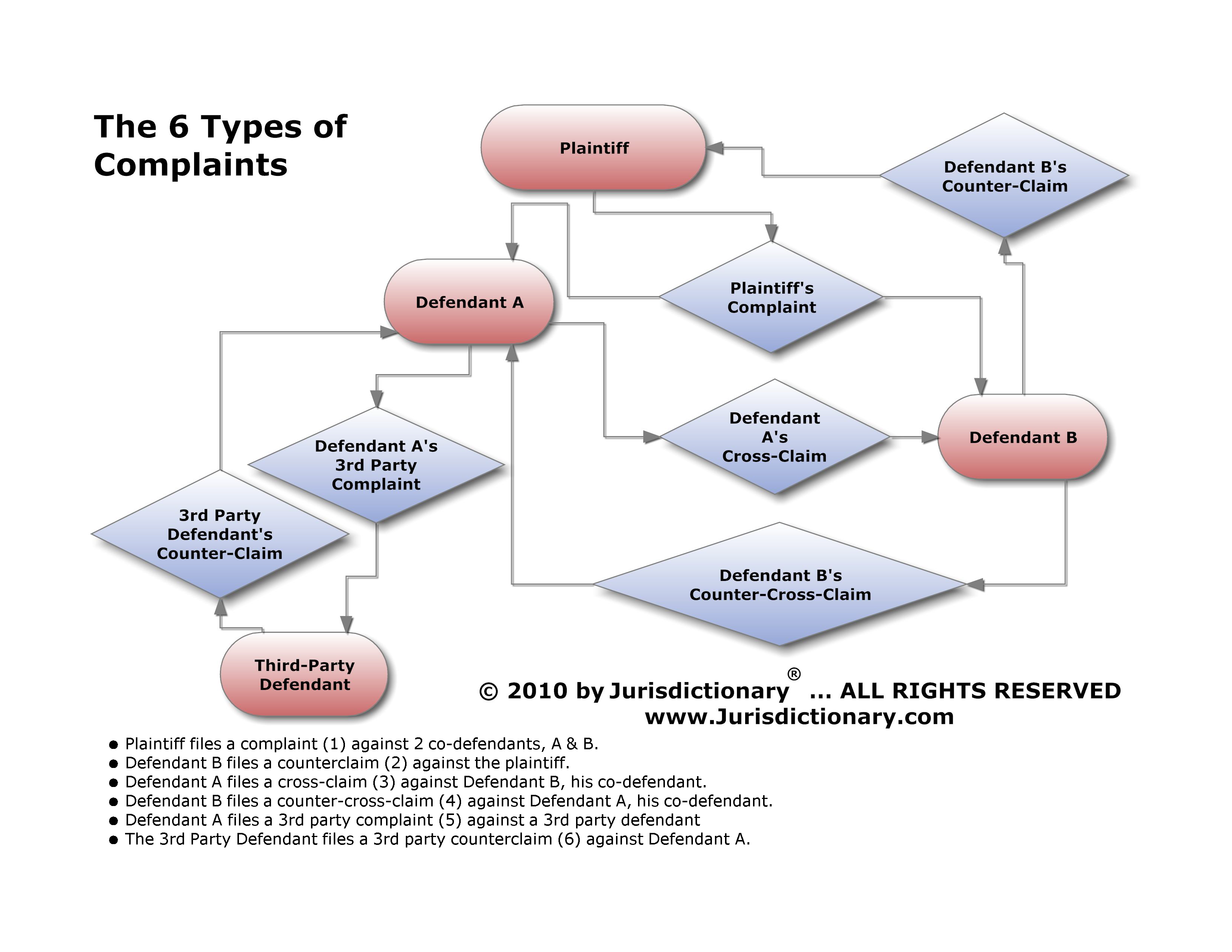
Complaint Components

Every proper complaint contains certain components.
-
Caption
-
Title
-
Preamble
-
Jurisdictional Allegations
-
General Factual Allegations
-
General Factual Allegations
-
Counts
-
Wherefore Clauses
-
Signature
-
Verification (optional but recommended)
Caption
The caption states the:
- Name of the court
- Division of the court
- Case number
- Judge's name (optional)
- Plaintiff names
- Defendant names
Title
The title tells it is a:
- Complaint or
- Petition
Preamble
The preamble says who is suing whom and what plaintiff wishes.
For example, "Peter plaintiff sues Danny Defendant for money damages arising from defendant's breach of a contract and states: ..."
Jurisdictional Allegations
Following the preamble the first few numbered paragraphs contain one sentence each alleging sufficient facts to allege the court has jurisdiction over the subject matter of the case and over the person of the defendant. (See samples below).
General Factual Allegations
In this section plaintiff alleges all facts necessary to establish the essential elements of every cause of action he is pleading. (Explained in Causes of Action class.)
Counts
Each count has a title that names the cause of action for that count, e.g., "Count One: Breach of Contract".
Each count then re-states the foregoing Jurisdictional Allegations and General Factual Allegations.
Each count then alleges all additional facts necessary to establish all essential elements of the cause of action included in that count.
Each count closes with a "WHEREFORE" clause moving the court for an order granting judgment favorable to plaintiff ... "together with such other and further relief as the court may deem reasonable and just under the circumstances."
Signature
At the bottom of the complaint, the plaintiff or his attorney must sign his name and provide his address, phone number, email, and any other information that will help responding parties to know who is bringing the case.
Verification
If the complaint is "verified" (explained later), the verification will appear below the filer's signature.
Single-Count Complaint
Here's a simple single-count complaint for breach of contract.
IN THE THIRTIETH JUDICIAL CIRCUIT COURT
IN AND FOR SUNSHINE COUNTY, FLORIDA1
PETER PIPER,
Petitioner,
v. DANNY DEFENDANT,
Defendant.
____________/
Case No. _____________ 2
Judge Benchpounder
COMPLAINT
Peter Plaintiff sues Defendant Danny Defendant for money damages resulting from breach of contract and states:
JURISDICTIONAL ALLEGATIONS
1. This is an action for money damages in excess of $15,000. [Explained below.]
2. At all times material to this lawsuit, Peter Plaintiff was a resident of Sunshine County, Florida.
3. At all times material to this lawsuit, Danny Defendant was a resident of Sunshine County.
4. All acts necessary or precedent to the bringing of this lawsuit occurred or accrued in Sunshine County, Florida.
5. This Court has jurisdiction.
GENERAL FACTUAL ALLEGATIONS
6. On 17 May 2012 Plaintiff and Defendant entered into a written agreement whereby Defendant promised to spray Plaintiff's 5-acre strawberry farm with insecticide every week for 8 weeks while Plaintiff was on vacation in Hawaii.
7. Plaintiff paid Defendant $3,000 at the time of execution of the contract in satisfaction of all the Plaintiff's obligations under the contract. [See where this is going?]
8. A copy of the written contract is attached as Exhibit 1. [Many jurisdictions require written contracts to be attached to complaints.]
9. Defendant failed and refused to spray Plaintiff's strawberries at any time, breaching the contract.
10.As a proximate result, strawberries valued in excess of $15,000 were destroyed by insects, causing Plaintiff to suffer money damages.
WHEREFORE Peter Plaintiff moves this Honorable Court to enter an Order for money damages against Danny Defendant, together with such other and further relief as the Court may deem reasonable and just under the circumstances.
Peter Plaintiff, Plaintiff
The caption tells us the name and location of the court, file number assigned by the court clerk at time of filing, name of judge, name of plaintiff, and name of defendant.
Next the title tells us this is a simple "complaint".
The preamble tells us plaintiff is suing defendant for breach of contract and seeks money damages.
The jurisdictional allegations include facts that give this court power over the subject matter of the pleading and the person of defendant.
The general factual allegations allege facts sufficient to establish the essential elements for a breach of contract case.
The "WHEREFORE" clause moves the court for an order declaring defendant indebted to plaintiff and for such other relief as the Court may deem appropriate.
The more you learn the simpler all this becomes!
Multi-Count Complaint
A multi-count complaint is the same as the single-count complaint, except that general allegations include facts to establish more than one cause of action, each with its own WHEREFORE clause.
In this complaint we'll add a second defendant just for fun so you see how easy it is to do.
A sample multi-count complaint follows:
IN THE THIRTIETH JUDICIAL CIRCUIT COURT
IN AND FOR SUNSHINE COUNTY, FLORIDA1
PETER PIPER,
Petitioner,
v. DANNY DEFENDANT and LARRY LAZY,
Defendants.
____________/
Case No. _____________ 2
Judge Benchpounder
COMPLAINT
PLAINTIFF Peter Plaintiff sues Danny Defendant and Larry Lazy for money damages and states:
JURISDICTIONAL ALLEGATIONS
1. This is an action for money damages in excess of $15,000.
2. At all times material to this lawsuit, Peter Plaintiff was a resident of Sunshine County, Florida.
3. At all times material to this lawsuit, Danny Defendant and Larry Lazy were residents of Sunshine County.
4. All acts necessary or precedent to the bringing of this lawsuit occurred or accrued in Sunshine County, Florida.
5. This Court has jurisdiction.
GENERAL FACTUAL ALLEGATIONS
6. On 17 May 2012 Plaintiff and Defendants entered into a verbal agreement.
7. Terms of the verbal agreement required Defendants to deliver Plaintiff's fresh-picked grapefruit to Plaintiff's customers.
8. Defendants promised to make daily deliveries, including Saturdays and Sundays.
9. Defendants promised to continue deliveries through the end of August 2012.
10. Plaintiff paid Defendants $5,000 in advance for the contemplated delivery services.
11. Defendants performed well for the first five weeks.
12. At some time in July 2012, Defendants stopped delivering grapefruit for Plaintiff.
13. Defendants began delivering their own grapefruit to Plaintiff's customers in competition with Plaintiff prior to the end of August 2012.
14. Plaintiff lost his long-standing grapefruit customers as a proximate result.
15. Plaintiff lost the value of the remainder of the season's undelivered grapefruit crop due to spoilage.
COUNT ONE: BREACH OF CONTRACT
16. Plaintiff realleges and restates the foregoing jurisdictional allegations and general factual allegations. [This brings the foregoing allegations into this count, so each count stands by itself.]
17. The 17 May 2012 verbal agreement constitutes an enforceable contract, since the contract was for services that could be performed within the space of one year pursuant to the Statute of Frauds. [Verbal contracts for services that cannot be performed within one year are unenforceable in states that follow the common law "statute of frauds". Google "statute of frauds" to learn more.]
18. Defendants were obligated by the contract they made with Plaintiff to deliver Plaintiff's grapefruit throughout the 2012 grapefruit season.
19. Plaintiff fully performed the contract by advance payment in full.
20. Defendants' failure to deliver through the entire 2012 season breached the contract.
21. As a proximate result of Defendants' breach, Plaintiff suffered substantial money damages.
WHEREFORE Peter Plaintiff moves this Honorable Court to enter an Order for money damages against Danny Defendant and Larry Lazy, together with such other and further relief as the Court may deem reasonable and just under the circumstances.
COUNT TWO: TORTIOUS INTERFERENCE
22. Plaintiff realleges and restates the foregoing jurisdictional allegations and general factual allegations. [Again, bringing those allegations in so this second count stands on its own.]
23. Prior to the wrongs complained of, Plaintiff enjoyed a profitable relationship with his former grapefruit customers.
24. Defendants gained knowledge of the identity and location of Plaintiff's customers in the course of their being employed by Plaintiff.
25. Defendants gained knowledge of the number and type of grapefruit that Plaintiff's customers purchased in the course of their being employed by Plaintiff.
26. Defendants gained knowledge of the prices Plaintiff's customers paid for Plaintiff's grapefruits in the course of their being employed by Plaintiff.
27. Defendants intentionally and without legal justification interfered with Plaintiff's relationship with his former grapefruit customers by selling grapefruit to them directly and at a competitive price.
28. As a proximate result, Plaintiff suffered substantial money damages.
WHEREFORE Peter Plaintiff moves this Honorable Court to enter an Order for money damages against Danny Defendant and Larry Lazy, together with such other and further relief as the Court may deem reasonable and just under the circumstances.
Peter Plaintiff, Plaintiff
See how simple it is?
Discovery by
Complaint
The plaintiff can use his complaint to begin discovering evidence.
The defendant can use her affirmative defenses to discover evidence, though it's not so certain as with a complaint.
First, we'll look at using the complaint to discover evidence. The same principle applies with the affirmative defenses.
The point is to allege facts the other side must admit (in addition to those necessary to establish the essential elements of your causes or defenses).
Once an opponent admits facts in his response, they are admitted for all purposes in the lawsuit and cannot later be denied.
Suppose it would help to prove Danny sold to Peter's customers if Danny admitted using Peter's truck to deliver Danny's grapefruit. Use of the truck isn't an essential element for either of these two causes of action, but it may be useful - if Danny admits it in his answer to the complaint.
(If Danny denies it in his answer, Peter may be able to use his five discovery tools to prove Danny is a liar! More on this in the "Discovery" class in this course.)
Peter might add a paragraph like:
19. Defendant used Plaintiff's 1944 Ford pickup truck to deliver Defendant's grapefruit.
But, didn't we say earlier to allege only facts essential to the causes of action?
Yes ... but not if we can get discovery with the complaint!
Allege additional facts beyond what is essential to establish causes of action only for the purpose of discovery!
Defendant will be required to answer the complaint sooner or later (unless he succeeds with a flurry of motions explained elsewhere in this course).
If he admits using the old truck, Peter won't have to use his limited number of valuable discovery tools to get that fact into the record.
If we're certain he'll deny it (and we won't be able to prove he's lying) there's no point putting it in the complaint. If he denies (and we cannot prove he lied) we gain nothing by alleging it in the complaint.
If he admits it in his answer, however, it's admitted for all purposes throughout the remainder of the case.
He cannot later deny it once he admits it.
So, add allegations of fact that if admitted will help you get at evidence you need to prove your case.
Pleading Paragraphs
This topic is so important it's a wonder law schools don't teach it.
Few lawyers are aware of the discovery power they miss by poorly wording each separate numbered paragraphs of their initial pleadings.
Each numbered paragraph should contain only one sentence!
One subject and one verb.
As few adjectives and adverbs as possible.
Compound sentences should only rarely be used.
Avoid conjunctions like "and", "or", "but", "however", etc.
Never use "and/or" if you can avoid it.
Sentences with mixed conjunctions open the door to argument about what you meant. You want each and every sentence (in all your legal forms) to mean one thing and one thing only!
Remember, the complaint is not merely a paper you file to "complain". It is your first bite at the discovery apple. You want each separate numbered paragraph to precisely state what it alleges, with no wiggle-room for your opponent.
Then, when defendant responds he must admit or deny each fact alleged.
Each admitted fact is admitted for all purposes.
A sentence like the following accomplishes nothing.
19. Defendant was aware Plaintiff was worried, but Plaintiff stood alone on the precipice of his financial defeat, while defendant watched with pleasure at Plaintiff's suffering, knowing the Plaintiff would be sad.
Who cares?
It provides no fact essential to any cause of action, and it certainly gives no opportunity for discovery. You gain nothing from such run-on, complex sentences.
If a word does not support a cause of action or offer opportunity for discovery, leave it out!
Consider the following:
19. Defendant spoke by telephone with an Acme Truck Repair employee on the 12th of June 2012.
If he admits, you won't have to prove the conversation took place.
If he denies, you can subpoena the Truck Repair company's phone records or depose the employee to prove defendant is dishonest and probably responsible for the damages your complaint seeks.
Compare the foregoing with this compound sentence.
22. Defendant was in Pittsburgh on 11 December 2012, and Plaintiff was unable to reach him by phone.
How can defendant know plaintiff couldn't reach him by phone?
He will deny, and you gain nothing.
Far better to use separately numbered - one subject, one verb.
22. Defendant was in Pittsburgh on 11 December 2012.
23. Plaintiff was unable to reach Defendant on 11 December 2012 by telephone.
Defendant may respond "Without Knowledge" to #23.
But he must admit or deny #22, and that will give you a possibly valuable point, whether he lies or tells the truth.
Make all single sentences numbered paragraphs - one subject, one verb, minimum adjectives and adverbs.
Write, re-write, and re-write your paperwork until perfect!
You now know what many lawyers never learn!
Conclusion

Pleadings allege what the pleader must prove to win.
It's that simple!
Justice is now in your hands.
IN THE THIererererer
rererer
Plaintiff,
v. DANNY DEFENDANT,
Defendant,
THEO THIRD-PARTY,
Third-Party Defendant.
______________/
Case No. 2012-123
Judge Benchpounder
ANSWER AND THIRD-PARTY COMPLAINT
DEFENDANT Danny Defendant answers the complaint of Peter Plaintiff responding to each numbered paragraph thereof,
1. Denied.
2. Admitted.
Danny Defendant, Defendant and Third-Party Plaintiff
[ Certificate of Service ]

The unauthorized reproduction or distribution of a copyrighted work is illegal.
Criminal copyright infringement, including infringement without monetary gain, is investigated by the FBI and is punishable by fines and federal imprisonment. No portion of this course may be published, duplicated, shared, or used by anyone other than the current subscribers.
© 1997-2025 by Dr. Frederick Graves
d/b/a Jurisdictionary®
All Rights Reserved
866-LAW-EASY ( 866-529-3279 )
19420 Heritage Harbor Parkway
Lutz, Florida 33558
lawbook@jurisdictionary.com
