Evidence
The Friendly Filters
Getting to the Good Stuff
Evidence Rules are simply “filters”.
That’s all they are.
That's all they do.
They filter “out” misleading garbage, falsified testimony, forged documents, and other things that should never be allowed to influence judge or jury.
They keep garbage out.
They decide what's good and what's garbage. They decide. Not the judge. And, when you know these rules you get the good stuff in and keep the garbage out so you can win your case!
The evidence rules work equally for both sides. They favor nobody. They are fair!
They work FOR you … if you’re the good guy who should win!
They work AGAINST you … if you’re a lying cheating scumbag who should lose!
Half of winning in court is getting your facts “admitted” to the record as evidence.
The other half of winning is preventing your opponent from getting his garbage in the record.
Stuff that you may think is evidence is actually useless until it is “admitted” into the record as evidence. It is not evidence until it is admitted. Please hold fast to this truth. People who say, “I’ve got all the evidence I need,” don’t understand this truth. Only the stuff that gets admitted to the court record is evidence. The rest is just stuff ... useless stuff.
Purpose
The Federal Evidence Rules say their purpose is to:
Without these rules Justice is impossible!
Your opponents will try to mislead the judge and jury with their “stuff”. Anticipate their games. It’s what lawyers do. It's how they make a living. They will cheat … if you let them!
By using the evidence rules tactically, however, you will stop them in their tracks. You will prevent their sneaky tricks. You will keep their stuff out and get your stuff in.
The evidence rules decide.
As you've already learned, every case (civil or criminal) begins by alleging the essential facts that each party must prove to win. The case then proceeds through “discovery” (You will learn about your discovery tools in a later lesson.) to get evidence that tends to prove that the facts alleged are true.
You win your case if you:
Once you do this, you move the court for an order declaring you the winner. (More on motions and orders in a later lesson. Don't go there now!)
Like everything you've learned so far, this is not rocket science!
Rule Categories

Just like movie genres (i.e., adventure, romance, mystery, etc.) evidence rules can be grouped into six (6) easy-to-understand categories.
Two R’s.
Two C’s.
Two P’s.
REMEMBER: Rapid Rabbits Can Catch Pokey Penguins
Relevance. Reliability. Competence. Credibility. Prejudice. Privilege.
Each of these decides what stuff is admissible as evidence and what stuff is just garbage.
Let’s take a closer look.
Relevance
Relevance is the First Filter.
If a party offers a fact not reasonably likely to prove or disprove a disputed issue alleged in the pleadings, that fact is irrelevant and fails this admissibility filter.
For example, whether or not a party was involved in a fist fight at a local tavern should not be admitted in a case arising from a contract dispute, unless the fight had something to do with the contract. It is not relevant. "Objection. Relevance."
Whether or not a party declared bankruptcy in the past is not relevant in a criminal case accusing him of murder. "Objection. Relevance."
Do not permit the judge, jury, or court record to so much as get a hint of any fact offered by your opponent, unless that fact is reasonably likely to prove or disprove a disputed issue, i.e., what we lawyers call a “material fact”.
If it’s not material, it's not relevant and, if it isn't relevant, it doesn’t come in … unless you let it in!
PERMIT NO EXCEPTIONS. (You will learn about objections in a later lesson. Don't go there now!)
Suppose you rear-ended plaintiff’s car while wearing flip-flops and also had your lover’s photo in your wallet. The flip-flops could cause your feet to slip off the brake pedal. But, the photo in your wallet (though you might have been thinking about him or her) cannot reasonably impact the outcome of the case. It has nothing to do with the issues raised in the pleadings. The photograph is “irrelevant” and fails this admissibility filter. "Objection. Relevance."
Reliability
Information provided by a witness (expert or otherwise) must be based on facts or data that can be verified through other sources or it is unreliable and fails this admissibility filter.
Testimony from a witness under the influence of narcotics at the time of testifying or at the time of events the witness is called to testify about is unreliable testimony, because it lacks reliability. It's value to prove anything is reasonably questionable. This rule should be used to keep it out!
Testimony of very young children may be inadmissible on this ground. Children talk to their toys. Very young children are deemed by our courts to lack the mental maturity to discern between fact and fantasy. Their testimony should be excluded by raising this rule with a prompt objection before the witness speaks!
Facts derived from artificial intelligence may also be excluded as unreliable unless backed up by facts established by other means. This new technology is already causing problems in our courts. AI is based on vast amounts of information, not all of which is accurate in the first place, and the algorithmic methods used by the technology are insufficiently precise to make them reliable when people's lives and livelihoods are at stake in court proceeding. Object to it!
Competence
A fact offered by someone with no first-hand knowledge of the fact is incompetent. The person offering the fact is incompetent as to the fact being offered as evidence. If a witness doesn't know, that witness should not be permitted to say!
You will encounter lawyers trying to tell the court “what happened”. He will slip this in if you allow it, i.e., if you do not instantly and forcefully object to prevent the lawyer from testifying. As soon as he begins to talk about what client said or what his client did or anything else that he does not know first-hand, shut him up with this objection! Use this rule! Lawyers will break it every chance you give them to do so!
Hearsay is objectionable, not because it is hearsay but because hearsay testimony lacks competence, just as a lawyer testifying about facts he does not personally know. When your opponent tries to get a witness to say “what someone else said” (as he will most certainly try to do if you allow it) stop him with an objection and do NOT let the judge overrule your objection! OBJECT AGAIN. Renew your objection so it is on the record that the judge is ignoring the rules so you can win on appeal if the judge's error causes you to lose.
The competence rule (like all the other rules of evidence) gives you prime authority to control judges by demanding that anything a witness does not personally know will NOT be admitted unless you allow it.
Stop incompetent stuff before it gets in.
If your opponent manages to sneak incompetent stuff in to the record (because you were asleep at the switch or didn't drink enough coffee) move the court immediately to strike it from the record. The judge heard it. The jury heard it. Striking it may help. But the damage is done. Drink more coffee and pay attention!
Credibility
Anything a reasonable person would not believe is deemed by our courts as incredible. Such stuff offered as evidence must be kept out using this admissibility filter.
For example, no witness should be permitted to describe the little green men that landed their spacecraft in his backyard. Even though spacecrafts and green men may exist, reasonable people do not believe in them, and this rule will keep such stuff out of the court's hearing and out of the record if you object before it comes in.
The testimony of witnesses convicted of crimes involving dishonesty can be discredited using this filter. If they were convicted of murder or mayhem (crimes that do not reflect directly on their honesty) this rule does not apply. Forgers, check kiters, perjurers convicted of such crimes must not be permitted to offer testimony against you in court. If what they offer will help you, don't object. But, if what they offer is going to hurt you, jump to your feet, bang your fist on the table in front of you, and loudly declare, "Objection! Credibility!" Then be ready to provide certified documentation of the conviction you are relying on to show their lack of credibility.
Testimony, documents, and other things offered as evidence from un-trustworthy sources lack credibility, and you must keep them out using this filter. What comes in and what stays out depends on you!
The apparent insincerity of a witness can bring this filter to bear on facts that a witness may allege. Watch their demeanor and body language. If they shift uncomfortably, avoid your gaze, or otherwise indicate they may be lying, give this rule a try. The judge may agree with you and keep them from offering falsified evidence that could hurt your case.
Prejudice
Testimony or documentation or things reasonably likely to confuse, mislead, anger, or shock the judge or jury or the public conscience are prejudicial and fail this admissibility filter.
For example, the photograph of a bloody, mangled child being loaded on a gurney and lifted into an ambulance at the scene of an accident scene may be relevant, reliable, competent, and credible ... but if its effect on the court outweighs its value to prove an issue in controversy (i.e., if its probabitive value is outweighed by the impact of undue prejudice) it is inadmissible as prejudicial.
Lawyers try to play on the court's sympathies and, to some extent, that is permissible. But, when it is done in such a way that the judge and/or members of the jury are tortured emotionally or otherwise influenced away from addressing the substance of the case aside from their "feeling", this objection should be made to prevent it. If the objection is overruled, renew the objection so the record for appeal shows that you gave the judge another chance to do what the rules require.
When the "probative value" of evidence (i.e., its ability to prove or disprove a material fact) is outweighed by the reasonable likelihood it will confuse issues, mislead jurors, waste time, or introduce cumulative fact, judges should sustain the objection on the basis of this evidence rule.
The prosecutor in a murder case should not be permitted to show the court photographs of the mangled, bloody head of the victim. The victim is dead (one of the essential fact elements in a murder case) but how badly the victim’s head was mangled is not an essential fact element. It's introduction offers no proof that the accused defendant committed the crime. The photographs can only inflame, shock, and anger the jury. Your objection should be sustained. The photographs stay out!
Privilege
Privilege is the right not to offer evidence or to prevent your opponent from offering evidence of certain things that are deemed by our courts to be privileged.
Privilege belongs to the person using this rule.
It does not belong to anyone else.
A defendant may use this rule to prevent a priest from testifying, but the priest cannot use the rule when the priest is on the stand. The defendant must object. The priest cannot, no matter what his clerical vows may claim to the contrary.
Facts communicated in confidence between certain classes of people (e.g., a married couple or a lawyer and his client) are privileged. They fail this admissibility filter. They cannot come it, unless you allow them.
A lawyer’s notes in preparation of a case are privileged “work product”. Opposing parties cannot compel them to be presented to the court.
Anything obtained illegally is privileged.
Privileges are created by law. They cannot be created by a party.
Wives enjoys a privilege to prevent husbands from testifying against them. Husband enjoy the same privilege. Either can assert the husband-wife privilege to prevent the other from testifying, if the facts communicated were shared between them in confidence and in a setting reasonably calculated to provide secrecy between them.
Clients enjoys the privilege of preventing lawyers from testifying against them about things communicated between them in confidence. But, a client can testify against his lawyer! The client owns the privilege, not the lawyer.
Note the italicized words. Not all lawyer-client, husband-wife, priest-penitent, conversations are privileged unless shared in a setting where the facts communicated were intended to be confidential. Idle chatter at a crowded restaurant or in the bleachers at a little league game is not privileged.
Lawyers have no privilege. Clients own the privilege. Only clients can assert this privilege. They may compel their lawyers to testify about confidential communications, but lawyers can never testify against their clients, unless the client allows by not objecting promptly to prevent it. [The only exception is if the client is stupid enough to tell his lawyer that the client intends to commit a crime.]
Priests and other religious leaders may not testify about confidential communications you made with them in a religious setting. Note the italics again. Casual comments on a golf course are not privileged. The confessional is inviolate. The golf course is not.
Some jurisdictions add privileges for communications between financial advisers and clients, counsellors and sexual battery victims, psychiatrists and their patients, etc. Always check and be prepared to cite the local official rules!
The #1 Question is always, “Who owns the privilege?”
Fifth Amendment Privilege
The most powerful privilege you hav is against self-incrimination provided by The Fifth Amendment to the U.S. Constitution … but it has limits!
You cannot "invoke the Fifth” when you just don’t want to testify. The Constitution doesn’t protect you from “testifying”. The Constitution protects you from testifying about anything hat would put you yourself in jeopardy of being criminally prosecuted!
If your testimony is just going to cost you money or embarass you or go against your “personal wishes”, this privilege will not protect you. If you persist in refusing to testify, you can be jailed for contempt until you decide it's a good idea to provide answers than to remain locked up.
If your answers to questions would not put you in jeopardy of being criminally prosecuted, like questions related to a contract or other business matter, you must answer ... or risk being handcuffed and placed in a small room from which you cannot escape until you are ready to answer.
If you are offered immunity for your testimony, this privilege disappears entirely. Immunity removes the jeopardy.
Moreover, under recent changes in our legal philosophies, unless you have a clear legal right not to testify, refusing to answer questions may be used against you as evidence of guilt. Caution is the best strategy.
This privilege can be waived in some situations. For example, a man on probation or parole may not refuse to testify on the grounds it would tend to prove he violated terms of his release. Other exceptions also exist. Again, consult local official rules.
Never assume the Fifth will permit you to remain silent.
Privilege Generally
Unless provided by law, none has a privilege to:
Each of us is duty-bound to comply with the rules and to comply with lawful attempts of Justice to get at the truth.
We have many rights, but none of those rights includes the right to do wrong.
The Oops Factor

Inadmissible facts should never be heard by a judge or jury.
If inadmissible stuff gets in by “accident” (often an intentional lawyer trick) immediately move the court for an order stiking it from the record, citing the appropriate evidence rule.
You can’t unring a bell!
Lawyers mislead judges, confuse juries, and will get you off your game if you let them. Be ready to object at the drop of a hat. Drink coffee. Stay alert. Anticipate their trickery. Silence your inner talker. Ignore the parking meter outside.
Offers of Proof

If your opponent objects when you start to interrogate a witness and, if the judge sustains their objection, immediately move the court to hear your "offer of proof", or the the evidence you were going for will never appear in the record for appeal. Your offer of proof will make clear on the record what your evidence was going to be.
The jury won’t hear while you examine your witness, because they will be excused while you make your offer of proof at a “sidebar” (with the court recorder close by taking down every word so it's in the record where you need it to be so the judge knows you're prepared to appeal if he rules against you).
The record is what you’re fighting to make. You learned this earlier. Never forget it!
If you can’t get evidence in and don’t make an offer of proof, you’ll have nothing to appeal if the trial judge rules against you. The record will not show what the evidence might have been. You cannot introduce new evidence on appeal!
Hearing of the Court
It is improper for lawyers to ask questions they know will elicit inadmissible testimony.
They will do it anyway ... if you let them!
It is strictly against the rules in every jurisdiction!
Federal Evidence Rule 103 requires judges to manage their courtrooms so inadmissible evidence is prevented from so much as being suggested IN ANY WAY!
But you are the one who must compel the judge to enforce the rules of evidence. They won't enforce themselves!
Preliminary Questions
Judges may rule in advance of testimony on the qualifications of persons scheduled to be witnesses. They will consider such things as existence of privileges, first-hand knowledge of the matter in question, etc.
These are preliminary questions and by them the court may consider facts not otherwise admissible, such as facts relating only to qualifications of a witness or nature of a relationship (e.g., attorney-client or doctor-patient).
Those irrelevant facts will heard only by the judge. The is excused during preliminary questioning.
Moving the court for preliminary questions challenging an opponent's proposed witness can prevent that witness from taking the stand and win your case in the long run!
Remainder of Writings
If your opponent offers any part of a writing or recorded statement (e.g., from a deposition or hearing transcript, an audio of video recording, an affidavit or any other document) you may then offer any other part or all of the same thing.
By offering any part of a writing or statement, you open the door for your opponent to offer the rest.
If part of a writing is favorable to you, while some is not, be careful when you offer the part you like, because you “open the door” for your opponent to offer the all or any other part.
Judicial Notice

Some facts are so indisputable that the evidence rules allow you to require the judge to certify them. This is done with a judicial notice. You obtain a judicial notice and get your indisputable facts in the record by filing a Motion to Take Judicial Notice.
Some indisputable facts can be difficult or prohibitively expensive to get in any other way.
If a fact is common knowledge or something about which no reasonable person can disagree, the judge should grant your Motion to Take Judicial Notice of that fact, and then that fact becomes part of the court record without your doing anything more.
Such facts must be clearly obvious, common knowledge, or officially recorded in sources that cannot be questioned.
This is a powerful tool in your case-winner’s toolbox. Few lawyers use it, because it tends to make judges work harder, and lawyers (unlike you) don't want to upset judges they think they have to please to win. You don’t have that problem. You don't have to please the judge. You need only to control the judge, using the rules of evidence and courtroom objections you will learn in a later lesson. (Don't go there yet!)
Court cases are not won by pleasing judges. They are won by doing what this course teaches!
A client wanted her rent deposit returned. The landlord refused, claiming my client destroyed a Brazillian peppertree in his backyard. I knew those trees were a nuisance plant in Florida. I filed a motion for judicial notice of that fact. The judge granted my motion. My client got her deposit back plus court costs and my fees. The landlord should have given her deposit back rather than fighting me.
Facts that can be judicially noticed are facts widely known, established from reputable sources, and needing no proof (e.g., May 1st was a Sunday in 2022).
When a Court “May” Take Judicial Notice
A judge may take judicial notice of any fact relevant to the issues in controversy, but he doesn't have to! He may do it on his own volition (i.e., sua sponte) or in response to a motion.
Judges have some discretion when taking judicial notice, e.g., whether The Beatles were great musicians.
When a Court “Shall” Take Judicial Notice
But, judges do not have discretion to refuse a judicial notice motion seeking to establish facts that are beyond any reasonable dispute if the fact is relevant to an issue raised in the pleadings. (More about pleadings in a later lesson.)
Examples are phase of the moon on a particular date, speed limit on a particular stretch of highway, the controlling effect of a statute or rule of court, acts of Congress or state legislatures, laws of any state, laws of foreign nations, official acts, rules of court, and facts generally known and not subject to any reasonable dispute (e.g., the value of a Brazilian pepper tree).
Effect on the Jury
All facts judicially noticed should be communicated to the jury.
Jurors should be instructed to treat them as true for all purposes, whether they personally agree or not.
If the judge will not instruct the jury about a judicially noticed fact, you tell them!
Jurors have no discretion to disagree with judicially noticed facts. They are "supposed" to accept them in their decision-making process. Whether they do or not is anyone's guess, because we almost never know what jurors actually think about when they are doing what they are impanelled to do. (More on this also in a later lesson.)
Use and Practice
Judicial notice can be overused. Nothing is gained by putting a judge to the trouble of taking judicial notice of a fact that's only remotely related to issues raised in the pleadings.
On the other hand, if an indisputable fact relevant to the outcome of your case will improve your chance for success, make your motion and support it with citations to controlling appellate court opinions that the judge must obey. (More on citations in a later lesson.)
If a corporation was administratively dissolved by the Secretary of State prior to its suing you, move the court to take judicial notice of that fact. Support your motion with certified documents from the Secretary of State. Then you won't be required to jump through a bunch of hoops to establish the fact that the plaintiff doesn't legally exist anymore and cannot continue with its lawsuit against you.
Much unnecessary delay and time-wasting arguments can be avoided by using this simple tool.
Presumptions

If we see someone walking off the edge of a cliff, we may presume he's in for a fall.
But, we may not presume that his fall will injure him greatly unless we can over the edge of that cliff. The drop may be only a few feet, or it may be several hundred. We don't know without more evidence!
Courts may presume things. But, they may only presume what admissible evidence supports.
If a clear day turns cloudy, the sky turns dark, and thunder rumbles in the distance, we may “presume” that rain is on its way. It may not rain after all. But, rain is more likely than not.
It can be presumed if our presumption is reasonably based on facts that are admissible according to the rules of evidence.
The word "presume" comes from two Latin words: have and before. To presume is to know something before it happens. But, presumptions can never be certain. They must be taken from “essential fact elements” (there’s that concept again).
If there are no clouds and rumbling thunder, no presumption of rain is permitted. It may rain. But, but rain cannot be presumed.
Suppose an elderly lady of diminished mental capacity dies leaving a will giving everything to her lawyer, instead of to her children. If the lawyer wrote the will, a legal presumption arises that he exercised “undue influence” to benefit unjustly from her death. Google "Estate of Carpenter, 253 So. 2d 697 (Fla. 1971)" or "Carpenter v. Longan, 83 U.S. 271 (1872)" to read actually appellate decisions about undue influence and this legal presumption.
This legal presumption can be “overcome” if the lawyer produces admissible evidence that the lady wanted him to have her estate, that she was in her right mind when she signed the will, and that she was known by neighbors to hate her children for the way they treated her. The lawyer wins only if he can rebut (oppose) the presumption with admissible evidence.
Legal presumptions are created by statutes and appellate court opinions. They cannot be created by either party to a case. Facts can be presumed “as a matter of law” if essential facts set out in the law are established with a “reasonable degree of legal certainty”.
Presumptions are the product of long standing appellate court decisions and legislative enactments. They decree that certain “facts” may be presumed from admissible evidence of essential facts if there is no credible rebuttal evidence.
Presumptions shift the burden to prove. The party seeking relief has the burden to prove the essential fact elements required to create the presumption. Once established, the opponent then must rebut the presumption, or the presumption sticks. In other words, once a presumption is made, the burdened party must present admissible evidence to show that the essential facts do not exist or that there is some alternative interpretation of the facts that meets the presumption.
Presumptions can establish unprovable facts.
A single presumption can win your case if not sufficiently rebutted.
Inferences & Circumstantial Evidence
Inferences are guesses.
They are not presumptions.
Inferences assume. They are not permitted to presume. There's a difference.
Decisions in court should never result from assumed facts. Yet, sadly, tens of thousands of innocent men and women are locked hopelessly in prison at this very moment. Some have been executed. Others have lost their homes, their children, their life savings ... all because a judge allowed inferences to be treated as presumptions!
Lawyers stretch facts to absurd conclusions, and losers fail to object. Common-sense goes out the courthouse window. Good people suffer.
Don't let it happen to you!
For an inference to be treated as a fact in its own right, it must be drawn from facts that are established in the record by admissible evidence, not from a series of inferences.
Inferences are not facts.
Inferences are the stuff circumstantial "evidence" is made of. Circumstantial "evidence" is not evidence!
Yet, tens of thousands suffer from its use by ambitious lawyers to get judgments and convictions where no direct evidence existed. It proves nothing!
To prove a thing is to make it certain. There is nothing certain about circumstantial "evidence". It is un-certain by its very nature.
It may suggest that some fact is more likely than not, but it proves nothing.
Only the truth is true. Nothing else is.
Only proof is proof, because proof makes things certain!
Tens of thousands enjoy secluded life behind bars because their lawyer was a fool.
Repetitive Evidence
Lawyers offer multiple papers and multiple witnesses to prove a single point, where one or two is enough.
Facts may be proven by one or two witnesses or documents. Further documents and witnesses or multiple questions asked of a single witness about the same facts serve no purpose other than to make the lawyer's case seem sounder than it really is.
Fourteen witnesses called to the stand to say a driver was drunk at the time of an accident is more than enough. Fourteen questions asked of a single witness about the same fact over and over is also too much.
Object!
The rules of evidence prevent repetitive evidence.
Don’t put up with it. Command the judge to control his courtroom!
Character Evidence
Character evidence is a person's reputation in his community, i.e., what people who know him think about his character ... not what he did or did not do in the past. It cannot be used as evidence as to what he did or not do in a case.
If Sam Sneaky is accused of theft in a criminal case, the prosecutor cannot (unless nobody objects) bring witnesses to testify about Sam’s “sneaky” reputation. Sam may be sneaky and still not be a thief. Sam’s reputation for sneakiness cannot be offered to prove he committed theft. His character is inadmissible to prove he acted in conformity with his reputation.
If he offers his own character in defense, such as calling his grandmother to testify, “Sammy was always a sweet little boy," then Sam opens the door for his opponent to bring character witnesses to tell how sneaky Sam really is, i.e., something they could not do until Sam opened the door by presenting his own character.
Character of Victims
The character of a victim is admissible only if offered by the accused, not by the victim.
If the pastor of a local church is run over by a cement mixer and loses a leg, the pastor’s lawyer cannot offer evidence about how faithfully the pastor served the community for 30 years, how he he’s married with three lovely children, or how one is an Eagle Scout, etc. His character has nothing to do with the issues raised in the pleadings. It is irrelevant and therefore inadmissible.
Character of Witnesses
Character of witnesses is generally admissible only to show credibility (i.e., reputation for truthfulness or its opposite). Evidence that a witness was convicted of a crime is admissible only if the crime:
If a witness was arrested but not convicted, his arrest is inadmissible.
Prior Bad Acts
Evidence of prior bad acts is generally inadmissible to prove a person acted in conformity with those bad acts. (Rules differ in some jurisdictions. Always check local rules.)
Prior bad acts may be admissible to prove other things, but they cannot be used to prove a party acted the same way with regard to issues now on trial.
Proving Character
Proof of character, good or bad, may be offered by opinion testimony or reputation in the community. You may present evidence of past conduct to prove character only if it agrees with reputation testimony.
Habit and Routine
Evidence of a person’s habit or the routine practices of an organization may be admitted to prove a person or organization acted in conformity with habit or routine. Habit and routine are not “character”. Habit and routine are based on what a person or organization is known to do.
If it was a man’s habit to take a cab home from his tavern after closing, his habit is admissible to show he took a cab home on a particular night after closing.
If routine practice of a business organization is to deposit payroll at a particular bank on a particular day of the week, evidence of this routine is admissible to show the business followed this routine on a particular occasion.
Habit and routine have nothing to do with reputation or character.
Subsequent Remedial Measures
If someone fixes a stairway after someone falls, the fact that they fixed it (subsequent remedial measure) cannot be used to prove that the stairway was faulty in the first place. Otherwise juries would unjustly conclude, “If he'd repaired the defective stairs in the first place, that poor fellow might still be alive.” That is an impermissible inference, because fixing the stairs does not prove that the victim's fall resulted from some condition of the stairs that was repaired. Causation is un-proven until plaintiff offers evidence that the condition of the stairs before the accident and repair actually caused the injury.
Lawyers this rule and try their best to persuade juries that subsequent repairs are “evidence”. Don’t allow it! The owner of a set of stairs may have no duty whatsoever to repair the stairs. Building codes may not require it. He may be making repairs as an act of good faith for those who use his stairs, an extra effort to make his stairs as safe as possible … beyond any responsibility to make repairs.
The law does not wish to impede or disincline people to do good. To allow remedial measures to be used as evidence of liability would encourage people to leave stuff in a dangerous condition. If repairs are going to be used against a defendant, why give plaintiffs more ammunition?
Subsequent remedial measures may be admitted to prove other facts, such as ownership of an apartment building, but they do not prove negligence.
Offers of Settlement
For similar public policy reasons, evidence that a party offered to settle is not admissible to prove liability. An innocent party may wish to offer settlement rather than going to the trouble and expense of fighting in court for what could be years with normal life at a standstill while the battle rages on. The rules forbid making reference to settlement offers at hearings, at trial, or otherwise in any way. They are confidential and “off the record”.
The only exception is where parties agree to settle, memorialize their agreement in writing, and stipulate that in the event of default a judgment may be entered without further proceedings. (Covered in a later lesson on stipulations.) If one party refuses to abide by the settlement agreement, the disgruntled party may present the ageement in court and obtain an order granting specific performance.
Otherwise, settlement offers are off-limits!
Opinion Testimony

There are two types of opinions permitted in court:
The rules treat them differently.
Lay Testimony
Lay testimony is not testimony by experts. It is testimony by ordinary people derived from their personal observation, i.e., their first-hand experiences. Lay witnesses may testify about what they actually know to be fact! Their opinions about the facts in controversy don't matter. The court should only hear what they actually know.
Lay witnesses have no special skills, education, or advanced training qualifying them to offer “opinions” about facts outside their first-hand knowledge. Only expert witnesses have that.
Suppose a lay witness saw the plaintiff’s crops wilting in the field and saw a certain chemical sprayed on the crops a week prior to their wilting. His testimony is admissible as to the spraying and wilting. But he cannot offer his opinion as to whether the chemical caused the crops to wilt. He is a lay witness, not an expert.
If he is asked to offer an opinion, object before he speaks. If his opinion is admitted, move to strike it from the record. Lay opinion is never admissible if it depends on special skill, education, or advanced training.
A lay witness may testify about an elderly aunt’s recent changed habits of personal hygiene, inability to balance her checkbook, getting lost on her way to the grocery store two blocks from her home, forgetting the names of her children, and such similar things about which he has first-hand knowledge. He may not tell the court his aunt suffers from dementia.
On the other hand, he may offer an opinion that his aunt should be supervised for her own safety, because that opinion does not require special skill, education, or advanced training. It is not an expert opinion.
Expert Testimony
Conversely, an expert witness may not testify directly about facts in a case. Expert witnesses have no first-hand knowledge of facts in a case. They know only what they've been told. They were not direct witnesses of any facts in controversy. They may only offer opinions.
They may never say what the facts are nor which party should win. It is only his special skills, education, or advanced training that makes him competent to offer opinions.
To qualify as an expert, a witness must submit to voir dire questioning by both parties as to his special skill, education, or advanced training. If the judge is satisfied a witness is qualified to offer an opinion with regard to facts in a case, the court will declare him an expert.
“Doctor Wisdom," your opposing lawyer may ask the witness, "If a 50 year old man were exposed to airborne fibrous asbestos having a median particulate size of 7 microns in volumetric concentration of 4 micrograms/liter for an average 40-hour work week over 18 months, is it more likely than not that such a man would develop adverse symptoms of asbestosis?” An expert can answer that question. A lay witness cannot.
Counsel may ask, “What are the symptoms of asbestosis, Doctor Wisdom?” If the expert’s description of asbestosis symptoms matches what lay witnesses have testified about the plaintiff’s symptoms and the conditions of plaintiff’s workplace, the jury may put two-and-two together as they choose.
Experts can be costly. If you can make your case without one, spare the cost. If you must have an expert, hire him early. Confer with him before trial. Make certain he can give the testimony you need. If you’re not sure he's honest, question him under oath with a court stenographer recording his answers before trial. Have him sign the transcript. Don't be surprised at trial by an expert who decides to testify later for your opponent. Many experts sell their opinions to the highest bidder. Don’t be blind-sided.
Hearsay

Hearsay is an out of court statement offered to prove the truth of what it says.
A statement made by someone who is not in court, where they could be cross-examined. If it is offered to prove that what was said by that someone who is not in court, it is hearsay. No biggie!
There are a few exceptions to the rule, but most exceptions are common-sense, not rocket science.
If your opponent attempts to offer a Christmas card from Aunt Suzy to prove his client stayed with the aunt in December last year, object! What the card says is inadmissible hearsay. Aunt Suzy is not in court. The card cannot be cross-examined. The card is being offered to prove the truth of what it says. You must act before the court can learn what the card says!
Hearsay is simple when seen this way.
Always remember it is hearsay only if it is offered to prove the truth of what it says! If it is offered for some other purpose, it is not hearsay. Be on your toes! If it smells like hearsay, object!
Affidavits and the Hearsay Rules
Affidavits can’t be cross-examined any more than Aunt Suzy’s card. They cannot answer questions like a live witness. A Notary’s signature at the bottom proves nothing. An affidavit may be filled with lies, and many are. It is merely a piece of paper on which the affiant (the person who swore to and signed the affidavit) makes a statement alleging certain facts. Those statements may or may not be true.
If the affidavit is offered to prove the truth of what it says, but the affiant cannot be cross-examined, the statements in the affidavit are “out of court statements offered to prove the truth of what they say". They stay out, unless you are asleep when your opponent offers to read it to the jury.
Keep them out!
Exceptions to the Hearsay Rule
Hearsay IS hearsay, exceptions or no exceptions.
Some out-of-court statements may be admitted if they fall into one of the exceptions. If the court allows an exception, you must persuade the court to acknowledge that it is, nonetheless, hearsay and should not be given the same weight as testimony offered in court subject to rigorous cross-examination.
Here are a few exceptions allowed in most, but not all, jurisdictions. Check local rules.
Statement Against Self-Interest
If a witness offers an “out of court statement” contrary to what’s best for himself, the statement may be admitted under this exception, because people do not usually lie about things that will hurt themselves.
People lie to get what they want. They do not lie when it will hurt them.
Dying Declaration
What a person said while believing his death was imminent is deemed sufficiently reliable that courts may allow such out-of-court statement to be admitted, because people do not usually lie when they are about to depart this life and face eternal judgment.
If a dying person allegedly said, “Joe embezzled $14,000 from my company,” the statement is inadmissible hearsay, but the dying declaration exception may allow jurors to hear and decide on their own whether Joe did what the dying man said. Remember that a witness may be lying about what he says the dying person said.
Remind the court that any witness, sworn to tell the truth or not, may lie through his teeth.
Excited Utterance
A witness may testify what an out of court person said if that out of court person was under extreme stress or excitement at the time he allegedly said it. (Whether he actually said it or not depends on whether the witness present in the courtroom can be trusted. Never forget this.)
Suppose Smith runs out of his shop at the sound of screeching tires and sickening “thump” to see the crumpled body of a victim lying motionless in the street. He also notices Jones, a passer-by, in a state of extreme agitation, trying to help the injured boy. As Smith approaches, Jones looks up with wild eyes and flaring nostrils, “That man in the red Corvette didn’t even try to stop! This is terrible! Oh, my! Oh my!”
Suppose also that a nice lady who works at town library is sued for the boy’s injury. She owns the only red Corvette in town. Jones, the passer-by, has disappeared and cannot be called for questioning. The only evidence that the driver was a man, and not the lady librarian, is an out of court statement made by Jones who is unavailable to be cross-examined.
Smith is called to the stand and says, “I didn’t see the accident, but a little man in a green suit trying to help the boy said, ‘That man in the red Corvette didn’t even try to stop!'”
The victim’s lawyer jumps to object, “Hearsay!”
The librarian’s lawyer responds, “Excited utterance, your Honor.”
The judge says, “Objection overruled,” and the hearsay is permitted to be heard.
You must make the jury understand that there may not have been a man in a green suit. Those words might never have been said. The witness can be lying! Jurors are not required to believe anything said by witnesses ... oath or no oath! Witnesses lie.
Authentication

Documents and things may be admitted as evidence only if they are authenticated.
Otherwise they are just stuff that cannot be cross-examined. To get documents and things admitted, you must authenticate them. It’s a sad day when you come to trial with photograph or copy of a document, thinking they shoiw what you need to win, then watch your case circle the drain.
Your opponent objects. The judge sustains his objection. And you lose what you thought you would win.
Uninformed people think they can wait till the last possible moment (like Perry Mason did in the old TV court dramas) then pop up with something their opponent doesn't expect. It doesn't work that way in real life. Documents and things need to be authenticated, and that needs to happen before trial and before hearings where you need them as evidence.
Canceled checks, photographs, .38 calibre shell casings, or the rusty rim of an old spare-tire will not be admitted just because you wish them to be admitted. They must be authenticated. Without authentication your stuff is just stuff … not evidence. The court wants to know what they are, where they’ve been, who had custody, how they got in your possession, etc.
To paraphrase federal Rule 901, you must show that your stuff is what you say it is.
Self-Authenticating Documents
Some documents are self-authenticating. Certified papers bearing the clerk’s seal and signature are self-authenticating. Documents under seal are always admitted … if the information they contain is relevant.
Don’t offer “copies” of official papers without original seal and signature of an authorized officer. Copies of seals and signatures are just copies.
Other self-authenticating documents include:
Non-Self-Authenticating Documents
Most documents require testimony of a witness (or admission by your opponent) to show an unbroken chain of custody, knowledge of signature, place and time of origin, and similar matters.
Seal or no seal, any document can be challenged for fraud. Authentication witnesses can be impeached.
Authentication of Things
Authentication of things always requires testimony from someone with first-hand knowledge of the thing’s authenticity, chain of custody, etc. If a dent or scratch in an object is potential evidence, a witness must testify he was in possession and control from the time the dent or scratch was made until the time of offering his testimony.
Requirement of Originals
Originals are required unless unavailable AND the original cannot be obtained by any means. Copies received in response to discovery (requests for production, subpoenas, and depositions duces tecum) are no problem, because producing parties cannot object when it was they who produced them.
If you must have originals, demand them and get them! Don’t take copies. Don’t take “no” for an answer!
If your opponent demands originals of critical documents like promissory notes, mortgages, or deeds, have a Notary (or court stenographer) make copies and attach a seal attesting that they are “true copies”.
 Lawyers will try to deceive the judge. Get used to it. That’s why there are more perjorative jokes about lawyers than all the other “professions” combined. Lawyers cheat. The Bar knows about it. We all know about it.
Use the tactics in this course so your opponents duck and cover.
Testimony by Attorneys
Never allow your opponent’s lawyer to testify! NEVER. NEVER ! ! !
Lawyers lack competence to testify about facts they learn from clients or others! They are not parties, so they cannot be witnesses. They get away with it every day, however, because foolish litigants allow it and lose.
If you let your opponent's lawyer tell the court “what happened” or “who said” or “someone did” without objecting, you hand your opponent his victory on a silver platter. At the instant he begins to testify, jump to your feet with, "Objection! Competence! Counsel is testifying!" If he insists on testifying about facts, move the court to order him to take the oath and submit to your cross-examination. He will back down.
Court battles are not parlor games. Don't tolerate cheaters!
Exceptions
The only exceptions are in opening and closing statements, and even here there are limiting rules.
NEVER allow lawyers to testify. Don’t put up with it! Object! Controlling the court is entirely up to you!

Many judges don’t understand the rules. The Chief Justice of the Florida Supreme Court said to me in a hearing where I was arguing against The Florida Bar over discovery abuses, "Judges don't understand discovery." Those were his exact words. It's in the record! Only YOU can prevent the opposing lawyer from breaking the rules.
If the judge overrules your objection, renew it so the appellate tribunal can see you gave the judge a fair opportunity to do what’s right and tried your best to stop the error.
Don’t expect judges to fight for you. They won’t. They aren’t supposed to. Winning is up to you.
Dealing with Perjury
Perjury is a
Unless all four essential elements are met, the felony punishable by imprisonment does not exist! False statements in court are not perjury simply by being false.
Perjury infects our courts and impedes Justice. It will kill your case if you don’t shut it down as soon as it appears. Witnesses lie in court routinely and get away with it if nobody objects to demand an opportunity to prove the testimony was false, material, intentional, and under oath!
Object then move the court for an orer to show cause why the witness should not be held in criminal contempt for perjuring himself.
Don’t let any witness testify until he takes the oath. If a witness wanders from the straight-and-narrow by even the tiniest amount, remind him he is under oath and subject to criminal penalties. Put him back on the straight and narrow!
If a witness says something false but honestly believes it is true, there’s no perjury. But, if a sworn witness intentionally says something untrue that goes to a “material issue” in the case, he has perjured himself and committed a felony as surely as if he stole the judge’s wristwatch at gunpoint.
Judges don’t like to be bothered with stuff like this. Bother them!
Examining Witnesses
There are two ways to squeeze evidence out of a witness on the stand.
On direct you can only ask questions. You cannot suggest the answers. You cannot make declaratory statements then require the witness to admit or deny those statements. You can only ask questions.
On cross-examination you can ask questions as on direct but also switch and make declaratory statements and require the witness to admit or deny the truth of those statements.
You can use cross with your opponent's witnesses, but you must use direct with your own, unless your witness becomes hostile and begins to undermine your cause.
Initial questions to ask when approaching a new witness are:
Make witness answer these questions before you proceed. This sets the stage, ensuring the witness knows you did not fall out of a coconut tree and that you mean business! Get the witness’s attention and keep it at all times!
Cross-Examination
Cross-examination is word surgery. It forces witnesses to admit facts they otherwise could hide from you. You tell the witness some fact then require the witness to admit or deny the fact. It’s marvelous fun if you do it correctly. It will lead to disaster if you don’t.
Don’t start off with cross. It will alienate the witness. Do your best to appear calm, cool, collected, and kind. Your goal is truth, not to rattle or intimidate the witness nor to imitate ignorant TV lawyers. Put witnesses at their ease when possible. Make them think you are their friend (You aren't!). You only wish to ask a few questions. You're just trying to get at the truth.
Start with simple questions. “What is your name please? Where do you live? Are you acquainted with the facts of this case? Which facts?” Be pleasant. You don't need to attack witnesses. You don't need to insult their intelligence. If it will help you win, let the witness think you’re a bumbling idiot. Works for Columbo. Might work for you! Do whatever it takes. Be yourself!
Once the pleasantries are out of the way, start telling the witness things and forcing him to admit or deny those things. When you know what he knows before he speaks, cross-examination forces him to spill the beans.
If the witness starts saying, “I don’t remember. It could have been. I can’t be entirely sure,” and other baloney he’s probably been coached to say, lay into him with surgical cross-examination. Tell him what you know to be true, then ask him to confirm it.
“Isn’t it a fact you were in Chicago on July 9, 2022?”
“I can’t be sure. Might have been.”
“Isn’t it a fact you bought a deep dish pizza at the original Uno’s downtown on that date?”
“I might have eaten there. I really don’t like pizza. My mother made me eat it when we were kids.”
“I show you what’s been marked Exhibit 9. Do you recognize it?”
“Uh. Let me see. Uh. Not sure.”
“Remember you are under oath.”
“Oh, ok. I see. It’s a receipt of some kind.”
“What date is printed at the top of the receipt?”
See how it works? You get the answers that you need in spite of hems and haws and might haves and don’t remembers. It doesn’t matter if he dodges an answer or two. Jurors aren’t fools. They smell liars. They hear the answers and read between the lines.
If your opponent starts cross-examining his own witness, stop him before the witness answers! Don’t let a single word come out of his witness’ mouth. He may not cross-examine his own witness.
Direct Examination
You cannot lead your own witness. You must plan a line of questioning in advance, starting with basics and building systematically toward what you need your witness to say. You “lead” the witness this way, without using leading questions. It requires a bit of planning, but it’s all just common-sense and planning.
Tell a friend to think of something. Doesn’t matter what it is. Then use a series of questions to discover what thing he’s thinking about. Don’t ask directly, “It is an apple? Is it a pear?” Ask, "Is is animal, vegetable, or mineral? Is it bigger than a loaf of bread? Is it alive?" Ask questions digging ever more deeply toward the thing your friend is thinking about. Most people can get it in less than 20 questions, no matter what “it” the friend was thinking of.
Now, think of your witness in court and how much easier your questions will be when you know what you want the witness to say! Start politely, asking things like, “What is your name, please? Where do you live?” Then, “What do you know about this case?” This will start a train of questions to get what you need.
All questioning should seek relevant evidence. There's no point going after irrelevant facts, unless they are reasonably calculated to lead to relevant evidence. Stay on the path. Don’t wander. One step at-a-time. Proceed from generalities to specifics.
If your witness turns “hostile” or lies and you can convince the judge your witness is hostile, you may be allowed to cross-examine your own witness and find what he’s trying to hide. Squeeze him on cross!
Circumstantial Evidence
Circumstantial evidence is an invention. It is not evidence.
Circumstantial evidence grasps at straws. It is a guess and nothing more, and inference based on facts but not factual in itself!
It is covered in depth by a later lesson. Don't go there yet. Finish this class first.
Motions in Limine
Any time prior to trial (and even during trial) any party may make a motion in limine (pronounced lim’-ih-nee) to exclude evidence the other party is trying or threatening to offer.
The term in limine means “at the threshold”. If your motion is granted it prevents things from happening before they can happen. If will block unwanted evidence before it can be offered or even hinted at!
Lawyers offer inadmissible evidence “accidentally on purpose” if you let them get away with it. Make this motion any time you anticipate that your opponent plans to ambush you with last-minute high jinks. If you do not, stuff will come in that your opponent knows is inadmissible. The jury will hear it, and they cannot un-hear what you allow. Bells cannot be un-rung.
Conclusion
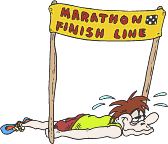
You now know more about evidence than many lawyers!
Use Google® to find and print the official evidence rules for your court. Get it from a government source, not from Billy-Bob's website. Memorize it. Take the print-out to court with you. Be prepared to cite the official rules.
Educate the judge if he disagrees with you! Don’t be shy!
Stay on the side of Truth and make Truth work for you!

The unauthorized reproduction or distribution of a copyrighted work is illegal.
Criminal copyright infringement, including infringement without monetary gain, is investigated by the FBI and is punishable by fines and federal imprisonment. No portion of this course may be published, duplicated, shared, or used by anyone other than the current subscribers.
© 1997-2025 by Dr. Frederick Graves
d/b/a Jurisdictionary®
All Rights Reserved
866-LAW-EASY ( 866-529-3279 )
19420 Heritage Harbor Parkway
Lutz, Florida 33558
lawbook@jurisdictionary.com
