Trial Prep And Procedure
If You Haven’t Won Already …
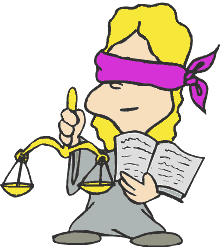
Trial is
So, why go to trial at all?
The necessity for trial usually results from one of the following avoidable causes:
Nearly all “winnable cases” can be won before trial. Less than 5% of cases go to trial. Do things the way this course teaches, and you should not have to go to trial if you have a winnable case!
However …
Some “winnable cases” are lost because they were taken to trial too soon!
Instead of being won before trial with powerful pleadings, forceful motions, detailed discovery, and effective pre-trial motions, those things are not done, so people lose by not doing to pre-trial work that wins routinely for people who do what this course teaches!
If you’re “down to the wire”, and your case is already scheduled to go to trial, there’s no more time to do the things you might have done sooner to win!
What you learn in this lesson may help you stand your ground for that last hurrah! It is your last hurrah when you hear the Bailiff say, "All rise!" You either win your case at trial or you lose. There's no going back to do what you should have done before trial. You either win now or lose. You get no more bites at the judicial apple.
You either have the evidence you need before trial or you will sadly discover it is nearly impossible to get it during trial, when your opponent is doing all he can to upset your applecart with objections and interruptions and calling for sidebars and even snorting or laughing or rolling his eyes at the jury and so it goes!
You can take no more depositions. You can serve no more interrogatories, requests for admissions, requests for production, or subpoenas. The time for compelling evidence from your opponent and other has passed you by.
Trial is your final chance to prove the facts you alleged in your pleadings!
So, concentrate on the facts in your pleadings and your opponent's pleadings, because no other facts matter when you get to trial. Your crooked opponent will try to twist things and make trial about something altogether separate from what was alleged in the pleadings. Don't be sidetracked!
Trial is no picnic in the park!
So!
Prove the facts alleged in your pleadings and undermine your opponent's attempts to prove the facts in his pleadings!
Nothing else matters!
Don’t let anything or anyone dissuade you from this single task ... not the judge, your opponent, an angry witness, or a sleepy juror.
Do not let your opponent put you on defense. Whether you’re the plaintiff or defendant, you must stay on offense at all times during trial ... assertively, effectively, and still politely!
If you let your opponent run you down rabbit trails, you will lose!
Stay focused!
Types of Trial

Trials may be held with or without a jury.
Jury Trial
In trials held before a jury, the evidence presented by the parties is weighed by the jury, and the law that determines the outcome based on the jury’s conclusion on the evidence is decided by the judge.
Judges may give “jury instructions” before the jury retires to deliberate, explaining how the law will determine the outcome of the case depending on how the jury weighs the evidence. In some cases you may be able to arrange for those instructions to say what you want them to say, provided they stick to what the law says.
Juries weigh the evidence presented by the parties. They do not decide the law or how the law applies to decide who wins.
On TV it may seem the jury issues the verdict when the jury foreman stands to say, “We the jury find …” In fact, the jury is following the judge’s jury instructions.
Present and explain the evidence in simple terms the average person can understand, because that's who you'll have in the jury box -- average persons, not rocket scientists, lawyers, or college professors. You'll have average people who can only understand average things. Talk over their heads and they will resent you and rule in favor of your opponent.
Civil Case
The burden of proof in civil cases is the “greater weight” of admissible evidence.
The job of juries in civil cases is to decide who presented the greater weight of admissible evidence.
Civil jury instructions might be something simple like, “Ladies and gentlemen of the jury, if you find the greater weight of admissible evidence presented shows the defendant entered into a binding contract with plaintiff, that defendant breached that contract by failing to perform, and that plaintiff suffered money damages as a direct result, you must find in favor of the plaintiff.” Notice that this is essentially the elements of a cause of action for breach of contract. Again, not rocket science.
Juries are instructed to "weigh" the admissible evidence.
Judges decide verdicts based on law applicable to the facts established by the greater weight of the admissible evidence.
Criminal Case
The burden of proof in criminal cases is evidence “beyond and to the exclusion of any reasonable doubt.”
Juries in criminal cases decide if the evidence taken as a complete picture creates any reasonable doubt as to whether the accused committed the acts described in the jury instructions given to them before they deliberated.
The jury instructions require them to decide based on the complete picture presented by the evidence whether to acquit or find the accused guilty.
A criminal jury instruction might be as simple as, “If you find, based solely on evidence presented to you, that there is any reasonable doubt whether the accused intentionally caused the victim’s death by gunshot wound, you must find the accused not guilty. If you find, based solely on the evidence that the accused did intentionally cause the victim’s death by gunshot wound, then you must find the accused guilty”.
The jury is not deciding whether the accused is guilty or not guilty. The jury is weighing the evidence and deciding if there is any “reasonable doubt”.
When the jury foreman "announces the verdict”, he is simply speaking for the jury's decision that must follow the jury instructions given by the judge.
The judge, ultimately, decides the verdict based on law applicable to the facts.
Bench Trial
Trials without a jury are called “bench trials”, i.e., decided entirely from the judge’s bench.
The judge weighs the evidence presented, applies the law, and enters the verdict.
Bench trials may be used in civil or criminal cases.
Equitable remedies (e.g., injunctions, rescission, etc.) are almost always bench trials.
Setting Trial
Trial can be “set” (i.e., scheduled on the court’s calendar) as soon as the pleadings are closed (i.e., when the last pleading is filed and the last motion directed to a pleading has been disposed of).
Trial can be “set” in several ways.
By a Party
Once the pleadings are closed, either party may file a motion to set the trial.
If there are no objections, the court will schedule a hearing (sometimes called a “docket call”) at which the court and the parties agree to a date and duration for trial, i.e., the length of time the parties and the court believe will be necessary to present the necessary evidence.
By the Court
If the court finds upon reviewing its docket that a particular case is ready to be set for trial, the court may set the date and duration sua sponte. It will then notice the parties for a docket call to discuss what date and duration is best.
Once set, it is very difficult to change a trial date!
Trial Sequence
The best outcomes in life usually result from a clear understanding of process … step-by-step.
Here is the sequence of steps at trial in most jurisdictions. Consult official rules in your jurisdiction to make certain this sequence applies where you are:
-
Jury Selection
-
Opening Statements
- Plaintiff (prosecutor in criminal case) goes first.
- Defendant (accused in criminal case) goes second.
-
Presentation of Evidence
- Plaintiff (prosecutor in criminal case) goes first.
- Defendant (accused in criminal case) goes second.
-
Renewal of Objections
-
Motions for Directed Verdict
-
Closing Arguments
- Plaintiff (prosecutor in criminal case) goes first.
- Defendant (accused in criminal case) goes last.
- Plaintiff (prosecutor in criminal case) may be allowed
rebuttal if closing argument by defendant/accused included
false statements of material fact or was inflammatory
and inappropriately prejudicial.
-
Jury Instructions
-
Verdict
-
Polling the Jury
Each of these steps is explained in the sections below.
Jury Selection
Jury selection is sometimes called by the French voir dire (pronounced vwahr diar).
Voir dire means “speak truth”.
It is, simply, a time when both parties are permitted to ask questions of various members of the jury panel (a larger number than will be required for trial) in an effort to decide which members will be favorable (or unfavorable) to the cause.
If you’ve received a notice to serve on a jury, you may already know the court calls a number of potential jurors in excess of the number ultimately empaneled for the trial. From this larger number, the respective parties are permitted to battle over which jurors they wish.
As you possibly also know, there are self-styled specialists who charge professional fees to assist in jury selection. These people operate on various theories and claim they can predict how an individual juror is likely to react to a particular party’s cause, evidence, argument, and objective. They cannot, however, predict with absolutely certainty how any juror is going to react to the dog-and-pony show the parties are about to present. Whether they use computer algorithms, body language and facial expressions, or a ouija board and crystal ball, the best they can do is always hunches based solely on general characteristics of human nature and its quirks that defy any definite prediction.
Humans are … well … human!
They are unpredictable.
If you can't afford a fancy jury selection team, use your common-sense and concentrate on:
Do not insult them!
And yet it is not wise to assume they understand what's going on.
Treat each as an old friend, wise, honest, kind. Smile. Make eye contact when you speak to them.
Do not permit some accidental slur or unpleasant facial expression to turn them against you. They will judge your case as much about you as about the facts and law.
They need to see you as their friend, the good guy in the room, the one that should win!
Every case is diffent, so it's impossible to list here the questions you should ask on voir dire.
Each juror is different, too. There's the side of themselves they show others and the inside that you cannot see. You can tell a lot from facial expressions, body language, how they dress, whether they sport tattoos, have neat or slovenly haircuts, and what kind of clothing they wear. But, what's going on inside them is always a mystery.
Think about your case, facts that will be presented with evidence, and circumstances that started the case in the first place, then ask the jurors questions to uncover how they personally "feel" about the facts and circumstances. Some may have backgrounds that will prejudice them against you. Others will have backgrounds that make them anxious to help you.
No two cases are the same. No two jurors are the same.
If a juror says something that would cause a reasonable person to believe he has a pre-conceived opinion of the facts and circumstances of your case that would pre-dispose him to rule against you, move the court to excuse that juror "for cause". The judge has the final say, but the judge's refusal to excuse a juror "for cause" can be grounds for appeal if you can meet the heavy burden of proving you lost because that juror was not excused.
If a juror looks at you angrily or is disrespectful when you ask questions on voir dire or otherwise gives you an uneasy feeling he will not be on your side, you may use what is called a "peremptory challenge" that the judge cannot overrule to have that juror removed. Peremptory challenges are limited in number. Check your local rules to see how many you can use.
Jury voir dire is more common-sense and sensitivity to characteristics of the human condition than any science, no matter what you see on TV.
The main thing is not to say or do anything that might make them secretly dislike you as a person or believe you think you are smarter than they are (though you may be smarter). Don't use big words. Don't wear fancy jewelry or expensive clothing to impress them or the judge, because at least some of them cannot afford fancy jewelry or expensive clothing.
Be on their level.
Be of them!
Opening Statements
Each side is permitted (but is not required) to make an opening statement before evidence is presented. This is to prepare the trier of fact for the evidence that will be presented.
It is NOT the time to tell what the evidence "is".
Proper opening statements tell what the evidence "will show", not what the evidence "is". Judges improperly allow crooked lawyers to vary from this rule and "testify" on opening. If this happens in your case, object, "Counsel is testifying!" The judge will likely overrule your objection, but the record will show the appellate court (if you must appeal) that the error was made and allowed. Renew your objection.
The Proper Way
When it's your turn to give an opening statement, tell the court:
That’s it.
You might say, “You’ll hear George Generous explain what he saw and heard at the scene of the accident. You will see a shredded tire Professor Knowsmore, an expert in tire technology, will tell you about. You will examine the record of defendant’s multiple convictions for criminal fraud and forgery.”
You don't tell them what George Generous saw and heard. You don't tell them that the shredded tire caused the accident. You don't tell them the defendant is a fraud and forger.
You let them reach their own conclusions.
Throughout the trial you need to let them reach their own conclusions. Don't force them!
The Wrong Way
You don’t say, “Ned Nasty knew the tire he installed on my motorcycle was defective and would likely cause an accident. Ned Nasty cannot be trusted. Ned Nasty owes me for my injuries.”
No!
Lead the jury (or judge, if it’s a bench trial) to reach the conclusion you desire.
Do not insult the court by telling it what conclusions it should reach!
Presentation of Evidence
Presentation of evidence is just that.
Each side calls witnesses, questions witnesses, and presents documents and things as evidence to prove (or tend to prove) the facts alleged in their own pleadings and disprove the facts alleged in the opponent’s pleadings.
Having excellent evidence is important. How you present your evidence is more important.
Both parties made allegations of fact in their initial pleadings.
Those are the only facts that matter at trial. (Don't let your opponent raise new issues.)
The only facts you need to prove with admissible evidence at trial are facts you alleged in your pleadings! Don't let your opponent run you down his sneaky rabbit trails. He will try. Count on it!
A crooked lawyer will make a big deal over non-essentials, facts that cannot have any bearing on the outcome. He will try to trick you into working to prove things that don’t matter! He will take you off your game. When you should be concentrating all your energy and skill on proving only those facts you alleged in your pleadings, he will confuse you and the court with facts that have nothing to do with the pleadings. "Objection! Immaterial. Outside the pleadings."
Nothing matters but facts alleged in the pleadings.
Visit court for entertainment. Sit in a few courtrooms and listen while lawyers battle it out. You will see for yourself. Lawyers routinely argue non-essentials to take their opponent off his game, to confuse the court, or just to waste time and charge their clients more money.
If either had done what they should have done (what this course teaches) they wouldn’t be in trial. They'd have won with solid pleadings and surgical discovery, instead of charging their clients for an expensive dog-and-pony show.
To learn how lawyers historically are known for dragging cases out for money, read Charles Dickens' Bleak House, Hard Times, and Barnaby Rudge. Lawyers get a bad rap for a reason!
Emphasize the how clearly your evidence proves your facts.
Scoff at your opponent’s evidence.
That’s what trial is for.
It's theater.
The time to win is before trial, not at the dog and pony show.
Who Goes First?
The order of presentation is determined by local law. Refer to the official rules.
Generally, the order is:
Demand the order set out in the official rules.
If the judge allows a different order, object! Cite the official rule and set the stage for a successful appeal if the judge’s error can be shown to have materially harmed to your cause.
Jury Instructions
Before the jury is empaneled, the parties should decide what particular instructions will be given to the jury by the judge.
In many cases, jury instructions may be helpful to assist the jury to properly apply the law to their decision on the weight and reliability of admitted evidence.
The court may require its own jury instructions (i.e., “Standard Jury Instructions” you can find using online legal research for your court) for issues frequently litigated, e.g., automobile negligence, breach of contract, etc. The judge will provide the jury with Standard Jury Instructions, if there are such that apply to the issues being tried.
Either party may also move the court to include additional jury instructions or for leave to amend the Standard Jury Instructions.
If there are no Standard Jury Instructions for a particular set of issues, either party may move the court to adopt jury instructions desired. There will be a knock-down drag-out fight if you and your opponent cannot agree, but jury instructions are extremely important and should be fought for so the jury understands how to rule on the facts presented to them.
Jury Charge
The judge will charge the jury with the instructions. Pay attention to what the judge says!
If you hear something that should not have been said, stand and politely but forcibly say, “Your Honor, may we have a sidebar.” After receiving permission, advance to the bench with your opponent and, out of hearing of the jury, explain why the jury charge given is incorrect and that the jury needs a corrective instruction. During the sidebar, make certain the court stenographer is recording every word!
Addressing the Jury
Throughout the proceedings, the jury is watching you! From the moment they enter the room, they are watching you!
They judge you by facial expressions more than anything, but they will also judge by your body language, your posture, your clothing, your tone of voice, your sincerity, whether you are polite in your manner, and whether you seem like a “good guy” whom they should favor ... no matter what the evidence may show.
There’s no predicting what juries will think or believe about you.
But, there is one thing that's absolutely certain. They will judge you!
Govern yourself accordingly.
Demand Order!
You are entitled to law and order!
You cannot make your case in an atmosphere of chaos. Do not allow interruptions. The exceptions are objections by opposition and directions from the judge!
Force the judge to maintain order. Do not be shy. They judge doesn't have to like you!
Do Not Allow Interruptions!
Crooked lawyers play every dirty trick in the proverbial book. Interrupting is the most commonly used dirty trick. Just when you’re getting to the most critical evidence, they will interrupt with some diversion to throw you off your track.
The judge should allow only one person to speak at-a-time. In reality, you will be interrupted again and again unless you stand up for yourself. It happens. Expect it.
Do not tolerate it.
As soon as it happens, move the court immediatey to order your opponent not to interrupt unless he is making an objection! If the judge denies your motion, object again! Take a quick glance at the court reporter to make certain your objections get into the record so you have grounds for appeal.
Judges are obligated to maintain “Order in the Court!” You are entitled to order just as much as you are entitled to an equal opportunity before the law!
Some crooked lawyers will turn an orderly courtroom proceeding into an all-out, no-holds-barred, backroom brawl.
Don't put up with it!
Do Not Allow Direct Argument
Crooked lawyers will “argue” directly with you. They will speak directly “to” you, instead of to the court.
Don’t allow it! Never allow the other side to speak to you directly.
Never!
When it happens (and it will) move the court to order your opponent to stop speaking to you directly and to address his comments to the court … not you! Make sure the court reporter is recording all.
Make Your Opponent Wait His Turn
Crooked lawyers will try to present evidence when it’s not their turn to do so. Don’t allow it!
Move the court to order him to wait his turn!
Trial is not a family argument in the kitchen where anything goes, but your opponent will try to rattle your cage every chance your give him by failing to speak up for yourself.
It isn’t right. But, it’s common, and only you can stop it. The judge will allow it if you do nothing.
Play fair and make everyone else play fair!
Conclusion
Trial can bring joy or be a horrible nightmare.
The key to making it easy and pleasant is to ask yourself, "Why am I here? What am I trying to prove? What am I trying to disprove?”
That's it.
All that stuff about who goes first, jury instructions, and voir dire is important, but more important is what you are in trial to do?
Stay focused on what truly matters, and you’ll do fine!

The unauthorized reproduction or distribution of a copyrighted work is illegal.
Criminal copyright infringement, including infringement without monetary gain, is investigated by the FBI and is punishable by fines and federal imprisonment. No portion of this course may be published, duplicated, shared, or used by anyone other than the current subscribers.
© 1997-2025 by Dr. Frederick Graves
d/b/a Jurisdictionary®
All Rights Reserved
866-LAW-EASY ( 866-529-3279 )
19420 Heritage Harbor Parkway
Lutz, Florida 33558
lawbook@jurisdictionary.com
