
Circumstantial Evidence
Don't Get Sucked In!
Eliminate Guesswork!
Circumstantial "evidence" is NOT EVIDENCE ! ! !
Circumstantial evidence is a reach beyond what's actually known to be true. It is guesswork, an attempt to "prove" something that cannot otherwise be "proven".
It "supposes" stuff instead of "proving" it!
It persuades judges and juries to reach conclusions that aren't supported by the evidence. It will bury you if you allow it.
It is abused every day by unscrupulous civil lawyers and zealous criminal prosecutors anxious to "prove" cases when they have no real evidence, no "clear facts", nothing directly in support of their positions. So they try to go "around the bush" so to speak, reaching conclusions that the rules of evidence do not directly support.
The only way to prove something is to make that something certain!
There is nothing certain about circumstantial evidence. The fact that it is used to created "evidence" where no evidence exists does not mean you must be victimized by its use.
Know the rules so you can stop it before it gets a foothold in your case.
This lesson shows how.
What Circumstantial Evidence IS

Circumstantial evidence guesses at truth! It is always no more than a guess! Let noone tell you otherwise.
Lawyers call these guesses "inferences", suppositions such as, "If that thing is round and red and edible, it must be an apple." You get the point.
Inferences are permitted, but they must be based onfixed facts that are absolutely certain!
Problems arise when inferences are taken from facts that are not certain, or taken from other inferences as if the other inferences were facts. An inference may never be based on another inference!
An inference may be permitted if and only if it is the only inference that can be drawn from the facts, and it must be reasonably drawn from the facts. It cannot be pulled out of thin air merely because it "seems" like it might be true.
Crooked civil lawyers and prosecutors frequently ignore this rule so they can win. It doesn't matter to them whether the outcome is right or just or honorable!
Many innocent people are behind bars at this very moment, or lost their homes to fraudulent foreclosure, or lost their children, or lost their life savings and their hope in Justice, because they hired a lazy lawyer or relied on a public defender who was too busy or too afraid to stand up to the judge and fight.
To win in court you must use the official rules and be prepared to fight!
When an opponent claims to have established facts to support an inference, when the "facts" he has are flimsy, inconclusive, or uncertain, drive a nail in his head at once! Only certainty is certain. Nothing else.
Take no prisoners! Master the case-winning knowledge and common-sense tactics in this course!
Circumstantial evidence is smoke-and-mirrors.
Some Legal History
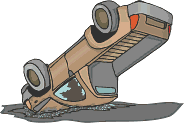
Google "Voelker v. Combined Insurance Co. of America, 73 So. 2d 403 (Fla. 1954)". Read it carefully. It's a 1954 case that sets some sensible rules for proper use of circumstantial evidence.
Mr. Voelker was found dead near his vehicle that had left the road and plunged into a drainage canal in the Everglades between Miami and Fort Myers. His body showed no signs of injury, though his vehicles was severely damaged.
The Voelker family sued the insurance company. The policy terms provided for recovery if death resulted from a vehicular accident.
It might seem Mr. Voelker died as a result of the accident. One might reasonably assume his death was caused by the crash. Just look at that mangled wreckage!
But, Mr. Voelker wasn't in his vehicle when he was found, and no physical injury to his body was evident.
It's the "seems" and "assumes" you must guard against and stop it before it can deceive judge or jury. You must instantly object as soon as it appears, prepared with citations to appellate decisions like Voelker. You must overcome the seems and assumptions before your opponent convinces a gullible judge or jury what "must have" happened without direct evidence in support.
The Court in Voelker wisely found another way to look at the facts and established a long-standing legal doctrine that an inference may not be drawn from another inference.
Mr. Voelker's remains were buried before trial, so, without an autopsy to prove the man died from injuries caused by the crash, that would have required the insurance company to pay, the family lost.
Without more to go by, the family was unable to prove Mr. Voelker did not die from a heart attack or other cause. The court refused to conclude that "just because" he was in a ditch near his wrecked vehicle that the accident caused his death. It's being "more likely than not" isn't good enough without direct evidence.
Most persons who haven't studied this course would say, "It's obvious Mr. Voelker's death resulted from the accident," but in a properly managed court of law it is not obvious.

If circumstantial evidence had been permitted on these facts, the insurance company would have been required to pay for Mr. Voelker's death, but his death could have resulted from other causes, and that prevented the inference that would have sunk the insurance company.
We will never know. There was no autopsy to determine for certain the cause of death. Dying from injuries resulting from the accident was not the only inference that could be reasonably drawn from the facts.
Allow no inferences from other inferences, unless the first inference has no possible reasonable alternative that can be drawn from the facts. Never allow a third inference under any circumstances!
Google "famous circumstantial evidence inferences" to find similar appellate decisions and learn from them. Be prepared to cite controlling appellate court decisions that interpret the rules of circumstantial evidence in your jurisdiction.
Never allow a judge to rely on inferences if the facts speak for themselves! Threaten appeal if he does!
What It Smells Like

You can "smell" when your opponent is laying a predicate for a circumstantial evidence attack on you. It stinks. Your opponent has no hard evidence and he knows it, so he moves into "conversational mode". He says those "you know what I mean" wanderings people use when they want you to guess at what they're really saying.
Ya' know?
You hear it every day. People can be talking about anything. Then, right in the middle of a sentence they stick in that phrase, "ya' know?". You don't know, but many people just assume they do know, even when in fact they have no idea what the speaker was truly thinking.
And when it happens in court it stinks, and it begins with informal "conversational mode". They have no hard evidence so they start talking like they're everybody's friend or next door neighbor. They turn off the formal presentation of facts and law and switch to an informal tone, hoping you and the judge and jury will accept what they're saying without thinking about it. People do this every day to make a point they cannot truly make. Ya' know?
Or you hear, "Everyone knows ...". Or, "It's clear as can be."
Well, it's not clear at all.
The Failed Mousetrap

Someone who hated my client set incendierary devices in his home to make it look like he started a fire to recover his insurance.
The devices were made with common mousetraps. Old-fashioned matches were attached to the striker arms of the traps so that (as it was intended to appear) if a mouse set off the trap, the matches would strike the edge of the matchbox, start a fire, and burn the cardboard boxes the traps were in.
Whoever did this was incredibly stupid, because unless the mice gnawed their way through the cardboard to get at the traps, the traps were never going to go off, and the fire would never start.
Further, it was found that the cardboard boxes were burned on the outside, not the inside. Indeed, the boxes were not entirely burned. There was evidence of a liquid accellerant in the living room as well as the kitchen.
The fire wasn't started by the traps. It had to be started by someone present in the building at the time.
My client sued his insurance company. The defense was that my client "had to be" the one who started the fire "because he was the only one with a key to his house". Smell that "had to be" inference?
It looked bad, but all that changed as the facts emerged.
The mousetraps in the boxes had snapped, and the matches were against the strikers on the matchboxes, but the wooden matchsticks were not burned. Only the phosphor tips were burned. Someone attached the matches to the striker, lit the match, then promptly blew it out. They expected the boxes to be burned so this deception would not be discovered. They expected the Fire Marshal to find the metal parts of the mousetrap and charred remains of the matchbox to conclude the trap started the fire and that my client did the deed "because he was the only one who had a key to the house."
The insurance company dragged its feet for nearly a year with its "had to be" defense based on my client's allegedly having the only keys, but they settled the day before trial.
Does having the only key make one an arsonist? Of course not. There must be more than one intervening inference to get from key to fire! Intervening inferences are not allowed in any state! The rules call it "impermissibly piling inferences" or "pyramiding inferences". If one inference is to be taken from another, the first inference must be established beyond every reasonable doubt.
Never cave in to circumstantial evidence games when there are self-evident, undeniable facts that squelch all possible inferences. Once all unsupported inferences are destroyed, and no inference can be drawn from another inference as its support, the circumstantial evidence game must fail.
Inferences are NOT FACTS!
Circumstantial evidence is NOT EVIDENCE!
Conclusion
Circumstantial evidence is too often used to confuse the court and undermine Justice.
Nothing in court is more commonly abused and misunderstood than circumstantial evidence. Inferences are made from inferences. Innocent people suffer. Families are torn apart. Businesses fail. Sometimes lives are lost. All because people don't know the rules or don't respect rules.
Do not allow inferences to be drawn from other inferences.
When you "smell" opponent's first attempt to use circumstantial evidence, jump to your feet and object. Take control of the situation. Cite controlling appellate decisions in your jurisdiction to put a stop to it!
Lawyers will muddy the judicial waters if you let them!
Don't get stuck in their mud.

The unauthorized reproduction or distribution of a copyrighted work is illegal.
Criminal copyright infringement, including infringement without monetary gain, is investigated by the FBI and is punishable by fines and federal imprisonment. No portion of this course may be published, duplicated, shared, or used by anyone other than the current subscribers.
© 1997-2025 by Dr. Frederick Graves
d/b/a Jurisdictionary®
All Rights Reserved
866-LAW-EASY ( 866-529-3279 )
19420 Heritage Harbor Parkway
Lutz, Florida 33558
lawbook@jurisdictionary.com
