Criminal Defense Tactics
Criminal Defense
How to Stay Out of Prison
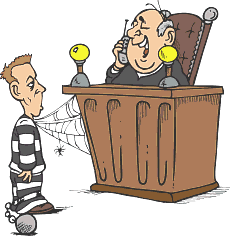
Being Innocent is No Defense!

Being “innocent” doesn’t mean you won't go to jail!
Lots of innocent people are in jail while you read this! Most are there because they didn't know what this course teaches and had a corrupt, ignorant, or lazy lawyer who was afraid of the judge!
This lesson is your “Get Out of Jail Free” card!
Many “innocent” people fill our jails and prisons. If you ask them, 9 out of 10 will tell you they’re innocent.
In reality, perhaps 10% or more are actually innocent!
This is unacceptable, but it is also reality. Innocent people are locked up in every jail and prison state and federal.
If you anticipate being charged with a crime or are already charged, you need to study this lesson carefully!
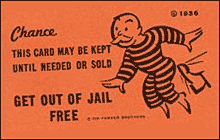
The best way to stay out of jail is: Don’t break the law! Don’t keep company with people who break laws. Avoid people who disrespect the law or criticize law enforcement. Stay away from people who say they shouldn’t be required to follow the law.
If you don’t hang out with law breakers, you minimize the chance of being accused of a crime.
But! Even if you’re “innocent”, you can be arrested and thrown in jail by mistake.
Study carefully!
What is a Crime?

There are many kinds of “wrongs”, but all fall into one of three categories:
Moral wrongs are as “wrong” as any other kind of “wrong”. In our system of law and order, however, there is no direct consequence to committing moral wrongs. There are consequences, but they come from a “higher court” and are invariably punished sooner or later.
Civil wrongs are “compensable wrongs”. Our legal system provides remedies to compensate people who suffer from civil wrongs. This course covers those civil remedies.
Criminal wrongs are “wrongs against society”. Not all crimes seem “wrong” to everyone, however those who commit such wrongs put themselves in jeopardy of punishment, because legislatures deem such wrongs as damaging to the general welfare and provide penalties for them by law.
In criminal cases, one of the parties is the government, e.g., State v. Jones.
Criminal statutes list the "fact elements” that must be proven beyond and to the exclusion of any reasonable doubt to convict the accused.
For example, theft in both state and federal statutes includes the following elements:
If a person accused of theft can satisfy the court with admissible evidence that he lacked intent to deprive the lawful owner of possession (as where the accused believed the property was his own and can show title or bill of sale to support his belief) he cannot be convicted, because the element of intent is absent.
The prosecution must:
The prosecution alone has this burden, and this burden remains on the prosecution throughout the court proceedings.
The accused does not have a burden to prove anything!
He should, however use every discovery option available to him (per the official local rules) to prove there are reasonable alternative theories the evidence supports to show there is a reasonable doubt OR that the prosecution has failed to present sufficent admissible evidence to prove ALL of the essential facts required to convict.
In civilized nations, you are “innocent until proven guilty”. You cannot be proven guilty unless there is NO reasonable doubt of your guilt.
Misdemeanors
Misdemeanors are referred to as “lesser crimes”. They are punishable by less than one-year in jail but can also impose a fine, probation, community service, and/or restitution.
Common examples of misdemeanors include:
Felonies
Felonies are “major crimes”. They are punishable by more than one-year’s imprisonment, fine, probation, community service, and/or restitution.
Common examples of felonies include:
Elements of Crimes

Just like civil cases, criminal cases are won (or lost) based on whether the essential elements of the alleged crime can be proven by admissible evidence.
As you learned in high school chemistry class, everything is made of elements. To make sulfuric acid (H2SO4) you must have three “essential elements” (hydrogen, oxygen, and sulfur). You cannot make sulfuric acid without all three. If you add another element, like phosphorus or selenium, you won’t get sulfuric acid. You’ll get something else.
The idea of “essential elements” is essential to winning in court. Essential elements in court cases are FACTS that must be proven by admissible evidence. To win any court case, civil or criminal, ALL essential elements must be alleged and proven.
In criminal cases the prosecutor must prove each and every essential element of the alleged crime by presenting admissible evidence that shows “beyond and to the exclusion of any reasonable doubt” that the accused is guilty of the alleged crime.
Knowing the “essential elements” of a crime is, well, “essential”!
Here are some places to find the essential elements of crimes.
The first should be presented to you when you are charged, so you know what the elements are. If neither is provided, file a motion for an order commanding the prosecutor to provide it. Otherwise you won't know how to defend yourself!
Then, prepare to prove by admissible evidence that at least one of the essential elements is missing or that there is an alternative theory of the crime that does not involve you as the perpetrator (i.e., the reasonable doubt defense).
Investigation

Long before anyone is arrested for a crime, there is usually an in-depth (sometimes very expensive, drawn-out, and intensive) investigation by law enforcement officers.
Information obtained by law enforcement is available to the accused upon written request for the entire file: identities of witnesses and what each will testify, documents, and everything collected by law enforcement that the prosecutor plans to use at trial.
You are entitled to know these things before trial.
Information gathered during investigation is discoverable, once your are charged and arrested.
Flaws in the manner of conducting the investigation, illegal searches, illegal seizure, breaks in the chain of evidence, missing evidence, misidentifications, and such like errors and omissions, can be used by you as grounds for acquittal.
Illegal Search
The Fourth Amendment to the U.S. Constitution is a safeguard to protect you from “unreasonable search”. Provisions of this Amendment are frequently used as defenses in criminal cases, where the investigation obtained property evidence protected by Fourth Amendment safeguards.
Search involves either visual observation or physical intrusion. Kyllo v. U.S., 533 U.S. 27 (2001).
Searches must be reasonable. A search is “reasonable” when the legitimate government interest outweighs its impact on individual privacy. U.S. v. Knights, 534 U.S. 112 (2001).
Fourth Amendment protection applies only when you have an objectively “reasonable expectation of privacy”. California v. Greenwood, 486 U.S. 35,39 (1988).
It is not enough for you to subjectively “believe” you have a reasonable expectation of privacy. The court must agree that your belief is reasonable.
Whatever you “knowingly” expose (in your home, office, or vehicle) is not protected. It is not “reasonable” to believe you have an expectation of privacy in things you allow others to see. Law enforcement cannot be expected to “look the other way”.
Anything that requires “intrusion” within your body (e.g., blood type, DNA, existence of a disease, etc.) is protected.
Protection is not extended to information or property you openly allow others to access. Bank records, conversation your next door neighbor overhears, or discarded paper your trash collector may come upon. Anything normally on display to others (including your voice, handwriting, and even your fingerprints) is not protected. The government can require you to submit to examinations of such matters without infringing your Fourth Amendment rights.
If you brag to your chums at a local tavern about some criminal act you committed, don’t expect the Fourth Amendment to protect you when those people “rat you out”. The information was “knowingly” revealed to third persons. The protection disappears.
Search of Residence
Fourth Amendment Protection
| Strong | Weak | None | |
|---|---|---|---|
| Residence | * | ||
| Year & Driveway | * | ||
| Public Areas | * |
If you hide a camera in a bedroom closet inside your home and prevent everyone in your family and all visitors from seeing it, that camera will be protected from seizure pursuant to the Fourth Amendment, unless a duly-issued warrant is obtained to gain access to your closet.
But, if you grow marijuana in your fenced-in backyard, and deputies in the Sheriff’s helicopter spot the plants from the air, courts will not allow you to complain you had a reasonable expectation of privacy.
The diagram shows how one’s home and the area around one’s home (curtilage) is treated by Fourth Amendment protections. Property within your home has strong Fourth Amendment protection, since it’s “reasonable” to believe the contents of your home are private. The area immediately outside your home (i.e., the yard, especially if fenced-in) is given moderate Fourth Amendment protection. The four factors courts apply are:
U.S. v. Dunn, 480 U.S. 294 (1987).
Non-Residence Searches
No expectation of privacy protection applies to an “open field”, fully exposed yard, unoccupied or undeveloped property … even if fenced and posted with “No Trespassing” signs.
A gold mine, for example, would enjoy expectation of privacy protection deep in its dark recesses, beyond the clear view of public passing outside or helicopters passing overhead, even though its “front door” stands wide open.

You do not have a reasonable expectation of privacy in a motor vehicle or other moveable conveyance. Police may search your automobile without a warrant if they have probable cause to believe the conveyance contains evidence or contraband. Pennsylvania v. Labron, 518 U.S. 938 (1996).
Illegal Seizure
Seizure is any interference with an individual’s liberty or possession of property. Michigan v. Chesternut, 486 U.S. 67 (1988). The Fourth Amendment is a safeguard to protect you from “unreasonable seizure”.
Seizure of a person may occur without “arrest” when a person’s liberty is deprived in any significant way (e.g., when detained for questioning, restrained by a reasonable belief that a display of authority prevents escape, or use of any physical force by law enforcement). Arrest, of course, is seizure per se.
Seizure of property occurs whenever law enforcement or other government agency takes or limits an owner’s possession of property.
Reasonableness of seizure depends on probable cause in all cases and issuance of a warrant is required in some cases. Police must have information sufficient to constitute “probable cause” in order to lawfully conduct a search or seizure.
Searches and seizures, even when justified, are confined by limitations of space and time defined differently by various jurisdictions. To learn more about probable cause, consult controlling appellate court cases in your jurisdiction.
Warrants are mandatory in some situations and discretionary in others. Again, you must consult controlling appellate court cases in your jurisdiction.
Your expectation of privacy attaches to you. It is not dependent on “where you are”. For example, you may have a reasonable expectation of privacy in a public phone booth, so long as the door is shut and you aren’t shouting into the phone so others may hear. Katz v. U.S., 389 U.S. 347 (1967).
Arrest
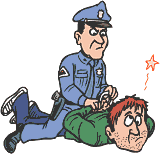
You don’t have to be face down with a policeman sitting on your back snapping handcuffs on your wrists for the courts to consider you to be “in custody” (i.e., under arrest).
You are “in custody” any time an officer deprives you of freedom in any significant way.
You are not in custody:
If you are deprived of freedom “in any significant way”, you are in custody.
Once you are in custody, you have the right to know the charge against you, and the officer is obligated to tell you the charge. Beyond that, the arresting officer has no obligation except as explained below.
What to Say
If you believe you are in custody (refer to the list above), you may ask, “Am I free to leave?” If the answer is yes, and you wish to leave, you may do so.
However …
The better policy is to be as cooperative as you can without saying anything that might tend to incriminate you (i.e., be used as evidence against you, even if for a crime you did not commit). You should always be friendly, open, cooperative, respectful, and do your best to help the police lay blame on the proper party ... because this is in YOUR best interest!
However …
If you are innocent as a lamb, you can still be thrown in jail and eventually be convicted and held for months or years for a crime you did not commit.
Be careful what you say!
You are not obligated to give any information.
However … there is no reason not to answer simple questions, such as:

Failure to answer such questions will work against you. Stubbornly refusing to talk, because you are angry at the government's intrusion into your life or believe you are "standing up" for some principle is stupid, and it will cost you in the long run.
You do have the right to remain silent, and if there are things you know you should not say, do not say them. But, if you choose to remain silent, say so out loud. Say, “I choose to remain silent,” rather than not saying anything at all. This will not prevent the police from talking to you, describing events, even explaining their theories as to why they believe you’re their man. You need say nothing further. But it is in your best interest to cooperate so long as you do not say anything that would tend to incriminate you.
You have the right to an attorney. You should invoke this right, even if you don’t believe you need a lawyer. You have the right to confer with a lawyer. You have the right to ask the lawyer questions. The lawyer may be able to get you “off” then and there. Do ask for one!
Once you invoke your right to counsel, do not speak. That’s what the lawyer is for. That’s why in mafia parlance, lawyers are called “mouthpieces”. Keep yours shut!
If after invoking you volunteer to answer questions, you may be questioned further. You still need not answer, but you’ve opened the door for more questions.
Miranda
In 1966, the United States Supreme Court interpreted the Fifth Amendment to protect against your being questioned without first being warned that your answers may be used against you at trial. Miranda v. Arizona, 384 U.S. 436 (1966).
There is no particular phrase required to meet the Miranda requirement, so long as the following is provided in the language of the accused, either verbally or in writing:
Police are not required to “Mirandize” you at the time of arrest, so long as they do so before questioning you while you are in custody. If you are not “in custody” police need not give the warning, as when an officer at the scene of a crime asks you, a bystander, “What did you see?”
What you say in such a situation can be used against you!
Confessions
Whether or not to confess is up to you and you alone.
If you decide to confess, you must first understand potential adverse consequences and possible advantages, and those things should be provided to you in writing!
If you are offered “a deal” by a law enforcement officer, know that law enforcement officers do NOT have authority to make deals other than to release you. They cannot change the charge. Only the prosecutor can change the charge. And, the prosecutor can only “recommend” sentencing. The judge is the final decider. If you are arrested and charged, whether you confess or not, sentencing is completely up to the court … not the police or the prosecutor.
For a confession to be used in court, it must be voluntary, i.e., not forced by threats, physical abuse, psychological torment, etc. Pressure must be viewed in the light of your condition, physically and psychologically, at the time.
The burden to prove voluntariness is solely on the prosecution. The measure of “voluntariness” is the preponderance (greater weight) of admissible evidence showing that the confession was, in fact, voluntary and not coerced or the result of trickery.
Police are allowed to elicit confessions, so be forewarned.
Entrapment
Law enforcement sometimes engage in activities that may encourage “pre-disposed” persons to commit crimes. This is perfectly permissible under the current status of our laws.
However …
When police encouragement operates to entrap someone who was not pre-disposed, consequent criminal proceedings may be vulnerable to the defense of entrapment.
These cases turn on several factors, the most prevalent being the accused’s pre-disposition. The accused's pre-disposition must “pre-exist”, i.e., it cannot be the product of law enforcement’s actions. Prior to contact with law enforcement, you must not have had a pre-disposition to commit the crime induced.
Law enforcement may “investigate” crimes. They may not “instigate” them.
Factors to evaluate this defense include:
Jacobson v. U.S., 503 U.S. 540 (1992).
Additional questions that may be used to evaluate pre-disposition include:
People v. Isaacson, 378 N.E.2d 78 (NY 1978).
First Appearance

This will be your first time in the courtroom after being arrested. The court should advise you of the charge(s) against you and provide you a document listing the charges.
Read this document carefully!
Know what crime(s) you are accused of committing and what all the essential elements are.
If you need more time to understand the charge(s), move the court for an order allowing reasonable time to carefully read the charges. The judge may decide to order pre-trial release, set an amount of bail, or remand you to custody without bail.
If bail is set or you are remanded to custody without bail, move the court to enter an order setting a bail hearing when you’ll be able to present facts and controlling law to support the court’s reducing the amount of bail or releasing you without bail. Most jurisdictions have recommended bail amounts and set circumstances under which bail should be set, waived, or denied.
Appointment of Counsel
This is when the court will decide if an attorney can be appointed for you. The court will evaluate your financial circumstances to determine if the government is obligated to pay for your court-appointed attorney.
Factors include:
If the court later determines any of these factors have changed, it may terminate funding your court-appointed lawyer, whereupon you will be obligated to either hire another lawyer or work out some arrangement to compensate the lawyer who’s been appointed for you.
Public Defender
You need to understand that lawyers from the Public Defender’s Office are burdened with many cases. Some of these lawyers are very competent. However, do not expect that a public defender will be able to provide the same quality of representation as an experienced, highly-regarded criminal attorney in private practice.
Attorney-Client Agreement
Just because the government is paying your public defender does not prevent your requiring a written attorney-client agreement as everyone should do when hiring the services of a lawyer.
The agreement will have nothing to say about how much the public defender is paid for representing you, but at a bare minimum it should require the lawyer to agree in writing to:
Many lawyers, including public defenders, are so high-minded they will resist considering you more than a know-nothing and resent any attempt on your part to participate in your case. If you find this to be true, demand a different public defender.
This is your life. A single moment of liberty stolen from you without your consent or knowledge is something you have a right to control to the extent of your ability to do so.
Do not be bullied by lawyers, whether public defenders or lawyers you pay money to fight for you!
Pro Se
You may waive your right to counsel and proceed pro se (without a representation) if you believe it will serve you to do so and you present your waiver of court-appointed counsel to the court:
You are not required to demonstrate any particular degree of legal knowledge.
You must, however, assure the court on the record that you understand:
If the court finds you competent to represent yourself, it should allow you to do so.
However …
The court may appoint “stand-by counsel” for your assistance, even over your objection. This is a good thing if you use the stand-by lawyer to help you understand what is happening to you. On the other hand, if you allow the stand-by lawyer to participate directly (e.g., questioning witnesses, arguing at sidebar, or similar efforts on your behalf), the court may deny your right to continue pro se.
It is seldom a good idea for pro se criminal defendants to testify.
Arraignment
If you were not given formal charges at the first appearance, you must be provided with them now. They should be in writing and spell out the exact charge(s). This may be in the form of an indictment or information.
Indictment v. Information
The prosecutor seeks felony charges from a grand jury that convenes to hear evidence obtained during the investigation. The grand jury then either returns an indictment (i.e., “true bill”) or declines to do so (i.e., “no bill”). The accused is not permitted to attend grand jury hearings unless called to testify as a witness.
If the accused waives his right to an indictment, the prosecutor can issue felony charges on his own with what’s called an information. An information may also be used, waiver or no waiver, for the prosecutor to issue misdemeanor charges.
Both have the same effect.
Plea
There are three possible pleas to a criminal charge:
A guilty plea admits all material allegations of the charging instrument. Where multiple charges are included, the accused may plead guilty to part and not guilty to the remainder.
For charges to which the plea is guilty, the accused waives all defenses. However, the accused may at any time prior to judgment withdraw his previous plea or any part thereof.
A not guilty plea challenges all material allegations of the charging instrument. Nothing is admitted. The prosecutor is put to his proof.
A plea of no contest (not available in all jurisdictions) neither admits nor denies allegations of the charging instrument. It has the same effect as a not guilty plea. The only possible advantage is that the accused is not required to admit anything that might be used against him in other proceedings, in employment applications, etc.
Pre-Trial Motions

Pre-trial motions in criminal cases are far too numerous to list, however the following are commonly used and may prove useful to you.
Motion to Dismiss
You may move to dismiss if:
Motion to Sever Defendants
The prosecution can charge more than one person for a single crime, resulting in all being tried in a single case. To be tried separately, you may move to sever defendants.
This may be useful when the prosecution has less evidence against you, and the guilty evidence against your codefendant(s) may taint your defense.
Motion to Sever Charges
When you are accused of multiple crimes in a single charging instrument, this motion is useful when evidence of the separate charges does not “overlap”, i.e., the evidence relates to entirely separate events.
This motion is especially useful when the charges for one crime are less likely to result in conviction, because if both are tried in the same case, the jury may tend to believe that because you are guilty of one crime you “must” be guilty of both.
Finally, you may wish not to take the stand for one charge but be willing to take the stand for another. If both are tried in one case and you choose to take the stand, you will be required to testify with regard to all charges.
Here’s an example:
MOTION TO SEVER CHARGES
Defendant, Bobby Badguy, pursuant to Rule 3.152, Florida Rules of Criminal Procedure, moves this Honorable Court to enter an Order severing charges of offenses joined in the same Information in the above-styled case and as grounds therefor states:
- Defendant is charged by a single Information with one count of Driving Under the Influence (Count I) and one count Refusal to Give Breath, Urine, or Blood Test (Count II).
- Under Rule 3.150(a), Florida Rules of Criminal Procedure (2011), two or more offenses may be charged in the same indictment or information when the offenses are based on the same acts or transactions or on two or more connected acts or transactions.
- Although granting or denying a requested severance is within the trial court’s sound discretion, a severance should be granted liberally when prejudice is likely to flow from refusing the severance. State v. Vazquez, 419 So.2d 1088, 1090 (Fla. 1982).
- The Florida Supreme Court has stated that, where a count requires proof of a prior conviction, it is better practice to sever the count so as not to deprive a defendant of the presumption of innocence. Id.
- In this case, proof of the current Refusal charge would require the State to present evidence of a prior DUI.
- Defendant’s prior DUI has no relevance to the current DUI charge, and would unduly prejudice Defendant by depriving Defendant of the presumption of innocence.
- Practicality and efficiency cannot outweigh defendant’s right to a fair trial. State v. Vazquez, 419 So. 2d 1088 (Fla. 1982).
- Furthermore, doubt as to the propriety of severance should be resolved in favor of Defendant, since separate trials could be held without harm to the interests of justice and, in turn, increase the likelihood of a fair and error-free-trial.
WHEREFORE, Defendant respectfully moves this Honorable Court to enter an Order severing Counts I and II from each other and to try each charge at separate trial.
Motion to Suppress Evidence
When the prosecution obtains evidence improperly (i.e., without a warrant, from search or seizure without probable cause, outside acceptable standards of the scientific community, etc.) you may file this motion to suppress improperly obtained evidence.
If your motion is granted, the court will issue an order commanding the prosecution not to use the suppressed evidence. If the prosecution introduces the evidence anyway, you will have grounds for mistrial.
Motion in Limine
Use this motion for an order preventing the prosecution from:
Motions in limine are similar to motions to suppress but address matters other than evidence.
Motion for Speedy Trial
The Sixth Amendment gives you the right to “speedy trial”. The government must commence trial within a certain number of days. (See official authorities.) Failure to commence trial within the speedy trial period results in dismissal of all charges.
This does not prevent the government from re-charging you.
In federal courts, the Speedy Trial Act of 1974, 18 U. S. C. §3161 et seq., provides that in “any case in which a plea of not guilty is entered, the trial . . . shall commence within seventy days” from the later of (1) the “filing date” of the information or indictment or (2) the defendant’s initial appearance before a judicial officer. U.S. v. Tinklenberg, 131 S.Ct. 2007 (2011).
The federal act lists some exclusions that may extend the 70-day period, so you must refer to the latest official authorities for a list of exclusions and how they may affect your case.
In state courts, the speedy trial “clock” may run for a shorter or longer period, and may start and stop at different times as in the federal courts. Always refer to the latest official authorities.
Here’s an example.
MOTION TO DISMISS FOR LACK OF SPEEDY TRIAL
Defendant moves this Honorable Court for an Order dismissing the indictment, because defendant was entitled to a speedy trial.
Defendant has been denied his right to Due Process of Law under the Sixth Amendment of the United States Constitution.
In support of this motion, Defendant attaches a copy of the docket sheet through 6 April 1993 and states:
- … [relevant facts listed here]
- … [relevant facts listed here]
- … [relevant facts listed here]
WHEREFORE the Defendant moves this Honorable Court for an Order dismissing the indictment.
Motion for Bill of Particulars
File this motion to obtain an order directing the prosecution to clarify language in an indictment, information, or other charging instrument. If any statements in the charge are unclear, the court will order the prosecutor to file a “bill of particulars” providing clarification.
Here’s an example.
MOTION FOR BILL OF PARTICULARS
Carl Conspirator respectfully moves this Honorable Court, pursuant to Federal Rule of Criminal Procedure 7(f), to enter an Order directing the government to supply the following particulars in reference to the indictment filed in the above captioned case:
- With respect to Count One, the date of the earliest statement and/or event upon which the prosecution will rely to prove the conspiracy existed.
- With respect to Count One, the nature of any and all statements and/or events, other than those already contained in the indictment, upon which the prosecution intends to rely to prove the conspiracy existed.
- With respect to Count One, the date and nature of the earliest statement and/or event upon which the prosecution will rely to establish when each defendant joined the conspiracy.
- With respect to Count One, the date and nature of the earliest statement and/or event upon which the prosecution will rely to establish when Carl Conspirator joined the conspiracy.
WHEREFORE, Carl Conspirator respectfully moves this Honorable Court to enter an Order directing the government to provide a Bill of Particulars as requested in this motion.
Motion to Change Venue
The Sixth Amendment guarantees your right to be tried “by an impartial jury of the state and district” where the crime is alleged to have been committed.
You may find yourself in a community from which it would be difficult to select a jury that’s not been infected by impassioned media stories of your arrest. Availability of witnesses and critical evidence may be located in another community. Venue may be improper based on official authorities in the jurisdiciton where you are charged.
This motion may be used to seek a change of venue when justice will be served by trying your case in another community.
Motion for Change of Plea
The accused may move the court for an order allowing him to change his plea at any time.
During the ongoing investigation that frequently occurs in the background while criminal proceedings move forward, both prosecutor and accused have opportunities to discover evidence that may favor the accused’s changing his plea.
An example might be discovery of a “smoking gun” under the accused’s mattress, forensically linked as the murder weapon. In such an unhappy event, the accused who initially pleaded “not guilty” may find a advantage to changing his plea to “guilty”.
Advantages (depending on official authorities in your jurisdiction) may include:
Consider the completely innocent fellow, cajoled by a public defender to plead guilty in exchange for the promise of a reduced charge. At a later time, the accused may discover the prosecutor has no evidence or has no intention of reducing the charges. A change of plea to “not guilty” in such a case would be wise.
Trial
Criminal trials are an unbalanced contest. On one hand, the prosecutor piles as much damning evidence as he can onto his side of the proverbial scales of justice. On the other hand, the accused presents evidence to show there are “alternative theories” of the crime that do not include his wrong-doing or that the prosecutor has insufficient evidence to prove all elements of the alleged crime.
The prosecutor’s pile of evidence must not only outweigh the pile presented by the accused; it must present the only reasonable explanation of how the crime occurred and why the accused is the one who committed the crime.
If the accused can demonstrate by his pile of evidence that alternative and reasonable conclusions can be drawn from the totality of evidence presented, he should be acquitted.
That may be an over-simplification but, in essence, that is what every criminal trial is.
Burden of Proof
The United States Supreme Court has firmly said, “We explicitly hold that the due process clause protects the accused against conviction except upon proof beyond a reasonable doubt of every fact necessary to constitute the crime with which he is charged.” In Re Winship, 397 U.S. 358, 364 (1970).
What “reasonable doubt” means to you is that evidence presented by the prosecution cannot be susceptible of any reasonable alternative interpretation that might conclude you innocent (e.g., some other fellow did it).
That is to say, if the evidence in its totality (yours and the prosecutions) could lead a reasonable jury to some conclusion other than your guilt, you must be acquitted.
This burden is always on the prosecution.
| Levels of Proof in Criminal Cases | ||
|---|---|---|
| Beyond Any Reasonable Doubt | Guilty | No alternative theory can be framed from the evidence |
| Reasonable Doubt | Not Guilty | Alternate theory can be framed from the evidence |
| Clear and Convincing Evidence | Not Guilty | Evidence of guilt is compelling. |
| Preponderance of Evidence | Not Guilty | Greater Weight of Evidence |
| Probable Cause | Not Guilty | Evidence of guilt based on reliable source. |
| Reasonable Suspicion | Not Guilty | Evidence of guilt based on facts. |
| Mere Scintilla of Evidence | Not Guilty | Some evidence of guilt. |
| No Evidence | Not Guilty | Not a trace of evidence of guilt. |
The accused is not obligated to defend.
Wise defendants, however, do all in their power to discover evidence on their own or construe the prosecution’s evidence to create a reasonable alternative interpretation.
In theory, you are innocent until proven guilty.
However!
You dare not sit idle doing nothing, foolishly thinking that because you are innocent that the prosecutor cannot possibly “prove you guilty”. For a jury verdict of conviction to be unassailable on appeal, the evidence must leave no loopholes, no reasonable alternative theory of the evidence.
Work like a beaver building alternative interpretations of the evidence, shining bright lights of legal authorities through every tiny loop-hole in the government’s case.
Create the reasonable doubt that can set you free!

The problem accused persons face in every jury trial (criminal and civil) is juror unpredictability. Surprises can come from the human beings empaneled in that jury box. They are just humans.
They have lives of their own, family, worries, things they’d rather be doing. Rarely do jurors wish to be sitting in a courtroom when they could be enjoying themselves somewhere else.
Some are as smart as you are. Some are smarter. Others are dumb as a sack full of peanuts.
In many jury trials with parties posturing, arguing, objecting, instructing, and generally creating as much chaos as possible, the evidence waters get so muddied it’s anyone’s guess what the jury may decide about the facts when the final vote comes in.
Jury

The jury is the fact-finder. Everything you do should be directed to the jury.
If you are testifying, look them in the eye with a friendly attitude and speak slowly.
If you are questioning a witness, ask so the witness speaks his answers to the jury.
Your future is in the hands of those nice people in the box!
Make them understand they are the stars of the show, not you, not even the judge!
In felony cases the jury is typically 12 men and women selected randomly from the community.
In less serious cases (and civil cases where a jury is called) there may be as few as 6.
Check local official authorities to be certain.
Role of the Judge
The proper role of the judge in criminal cases is to:
A judge normally does not make findings of fact, assigning that task entirely to the jury both at the beginning of the case and when giving jury instructions before they retire to deliberate. Occasionally, however, the jury’s verdict so utterly departs from any reasonable interpretation of the evidence that the judge may exercise discretion to enter an order reaching a different verdict, notwithstanding the jury’s decision or simply order a new trial.
A judge’s rulings may in such results be appealed but, for the purpose of managing a criminal trial and all proceedings leading up to trial, the judge’s rulings on evidence and law are final.
Decision to Testify
You have the right to testify on your own behalf.
However …
It may not be a good idea to testify, because the following otherwise inadmissible evidence may be used to impeach the credibility of your testimony if you take the stand:
If you are guilty and represented by counsel (who knows you are guilty) your lawyer cannot allow you to take the stand and lie. If he knows you intend to lie, he is required to withdraw. This would certainly be a black eye for you!
People charged with crimes make poor witnesses. They are nervous and, even if innocent, their nervousness can be interpreted by the jury as a guilty mind. Not good!
The Fifth Amendment grants you the right not to testify. If any of the above might even remotely tend to apply, use this right!
Choosing not to testify cannot be used against you as evidence of guilt. Griffin v. California, 380 U.S. 609 (1965). The jury may, however, in its all-too-human way of thinking, subconsciously or even consciously, in the strict privacy of the jury room, take your decision not to testify as your fear of being “found out”. Nobody can pierce the privacy of that jury room or predict what jurors will think.
You waive your Fifth Amendment privilege by taking the witness stand, so think twice! The truth can be tortured out of you by cross-examination if you decide to testify, and your attempt to plead the Fifth from the witness stand will fall on deaf ears.
Your Control of the Case
Certain decisions can only be made by the accused:
In other words, all decisions affecting your “fundamental rights” are within your exclusive control. Taylor v. Illinois, 484 U.S. 400(1988).
Your Lawyer’s Control of the Case
To the extent that they do not override those listed above, the lawyer has authority to control:
Your lawyer is not required to follow your directions or to proceed with any particular legal theory or overall strategy you may wish him to present. Jones v. Barnes, 463 U.S. 745 (1983).
Right to Press Coverage

In general, the press may attend any proceedings not involving a “sensitive issue” (adoption, rape, national security, etc.).
The press may or may not be allowed to use video, photography, or audio recordings, depending on the nature of the case, applicable law in the jurisdiction pertaining to press coverage, and the court’s discretionary rulings.
Gag Orders
In cases involving sensitive issues (e.g., rape, national security, etc.) the trial judge has discretion to enter orders commanding participants to refrain from communicating to persons outside the court about any information gained during the proceedings.
Gag orders are rarely issued.
The consequence of disobeying them, however, can be extremely severe!
Trial Proceedings

Jury Selection
Juries are summoned from the community at large. They are people from every walk of life, old and young, male and female, rich and poor.
A larger number than expected to be required is commanded to appear prior to the proceedings. From this larger number a smaller group is selected from which the jury itself will be selected. The number selected varies between jurisdictions and the charge being tried.
The critical qualities of a “good juror” are impartiality and willingness to follow the law.
Peremptory Challenges
Each side has a certain number of “peremptory challenges”. This varies from one jurisdiction to another, depends on the nature of the crime being tried, and is subject to further modification by the judge when the interests of justice require.
Peremptory challenges are not subject to appeal, provided they are not invidiously made (e.g., on the basis of race, religion, national origin, etc.)
If a party does not wish blue-eyed people on the jury (offered here only as an example), they may challenge blue-eyed members of the jury pool, provided they do not go beyond the allowed number of peremptory challenges.
Peremptory challenges need not be explained. If you use one of your peremptory challenges to remove a blue-eyed person, you need not tell the court you are doing so because of the color of his eyes. It is your right to make these peremptory challenges without explanation.
Challenges for Cause
Each side typically has an unlimited number of “challenges for cause”. These challenges must be made “for good cause”, however. A reasonable, justifiable basis must be stated, explaining why each such challenged juror should be excused from service.
Challenges for cause may include:
Anything that might tend to bias a juror or interfere with his ability to honorably carry out the responsibilities of adjudging the evidence according to the law as explained by the judge is proper grounds to challenge a juror for cause.
Opening Statements
In nearly all jurisdictions, the prosecutor makes his opening statement first.
Prosecution
It is improper for the prosecution to tell the jury what the evidence IS. Any attempt to do so should be responded to with an objection for the record. The judge may be unwilling to sustain your objection, however the objection makes your record and, if it turns out that the prosecution told the jury evidence that the prosecution later was unable to present, and if that “imaginary evidence” tended to influence jurors with regard to the verdict, the error may be grounds for successful appeal.
Prosecutors are not witnesses. They do not have first-hand knowledge of anything!
As explained in the lesson on “Evidence”, lack of first-hand knowledge of the facts renders the prosecutor (or any person offering “evidence”) incompetent to testify.
Competence requires first-hand knowledge. Prosecutors don’t have it.
If you hear the prosecutor “testifying” that certain facts exist or what those facts are (whether in opening statements, closing arguments, or during the heat of trial battle, object! Make your record for appeal.
If the prosecutor wants to get facts into the record, he needs to call witnesses and produce documents and things to do so ... not to merely tell the court what those facts are!
A proper opening statement tells the jury what the evidence will show!
Defense
The defense opening statement should follow the same rule.
“Ladies and gentlemen of the jury, you have heard the prosecutor tell you what the evidence will show, but when you hear for yourself the witness testimony and examine the documents and things presented for your consideration, you will see that the evidence does not show what the prosecutor alleged in his opening statement.
“In fact, the evidence will show …" [Here you provide your own version.] “You will hear the County Coroner testify that the victim's time of death was more than three days prior to discovery of the victim’s body. You will be shown evidence that the accused was in Sacramento, California from five days prior to the time of death until less than 24 hours before the body was discovered. You will draw your own conclusions."
Be polite!
Do not talk down to the jury. Talk to those people as if they were friends with whom you forever wish to remain in good standing, friends you would be pleased to invite for dinner at your home, people with problems of their own, people who care about you and your problems.
The way you treat others is usually the way they’ll treat you!
Do not insult them with statements like, “Any person with half a brain can see I didn’t commit this crime,” or, “You didn’t leave your common sense at home when you came to court today, did you?” Of course they didn’t. And, even if they did (some probably did) such statements are insulting and tend to make jurors look for ways to get you back … and that’s not good for you!
Be yourself. Be relaxed. Don’t use words regular folks don’t understand. Don’t leave your common sense at the courtroom door!
Tell the jury what the evidence will show and then tell them you are assured that they will reach the correct decision after carefully considering all the evidence.
Prosecution Case
After opening and closing statements are made, the prosecution will be permitted to call witness and present documents and tangible evidence.
What you learned in the class on “Objections” will be your mainstay.
You must be on-your-toes, at-the-ready to object whenever the prosecution attempts in any way to present inadmissible evidence, e.g., by leading his own witnesses or presenting documents and things not been previously authenticated, etc.
Many prosecutors are reasonable, unwilling to cross-the-line to get an unjust conviction. Others, however, form opinions of guilt based on facial features, body language, or even skin color or manner of dress. Expect violations of the rules and be prepared to object and make your record for appeal every time the prosecutor crosses the line or even gets dangerously close to doing so.
Defense Case
Refuse to begin until the court recognizes that the prosecution has closed his case! You do not want the prosecution to jump up suddenly, after you’ve begun, saying, “Oh yes, your Honor, we wanted to make another point clear.”
No! Make the prosecutor play his hand, sit down, and acknowledge that he has nothing more before you begin. He needs to say, "I rest my case!"
At that time you might move the court for a “directed verdict”, explaining that the evidence thus far presented is insufficient to convict. If the judge denies your motion, you made your record for appeal. If the judge grants your motion, you go home a free man.
Avoid the tendency to “defend”. That is the wrong tactic! Be always on the offense! As you learned in the lesson on Affirmative Defenses, the better tactic is to affirmatively present evidence and provide an “alternative theory” of the case that does not implicate you!
If this requires tearing holes in the prosecution’s evidence, by all means do so.
But!
Don’t forget that the prosecution’s burden is to prove your guilt “beyond and to the exclusion of any reasonable doubt”, and it is “alternative theories” that create the most powerful doubt possible.
Prepare your own witnesses, as explained in the Evidence class in this course. Do this not by telling them what you want them to say but, rather, by explaining how you are unable to lead them and how you need them to answer your questions with the charges against you in mind. Explain those charges to your witnesses before trial, if you possibly can. Ask them what first-hand knowledge they have about the facts alleged against you. Ask what other persons they might know who could have first-hand knowledge of those facts.
If you need to present documents or tangible objects as evidence, be sure they are authenticated or that you have a witness to authenticate them on the stand, or the prosecution’s objections will be sustained, and you will lose your advantage.
Present your witnesses, documents, and tangible evidence in the order you would present them if you were telling your story to a child. That’s not to say you treat the jury like children, for that’s a definite no-no. However, the order of presentation should be such that it starts with the most logical foundation and builds to the most logical conclusion: Your Innocence!
Closing Argument
As is true with opening statements, in most jurisdictions the prosecution goes first. The defense follows. And, if the defense raised issues not touched upon in the prosecution’s closing, the prosecution may make a final rebuttal statement addressing only those issues raised for the first time in defense’s closing.
On closing argument remind the jury what you said on opening. Remind the jury that the evidence promised by the prosecutor was not presented. Remind the jury what evidence in your favor that they did see and hear.
Now you may ask them, after considering all the evidence, to acquit you of the alleged crime.
Jury Charge
The judge will charge the jury with instructions, explaining how the jury is to consider the evidence, how they are to apply the evidence to the law, and the conclusion they must reach if the evidence fails to remove “any reasonable doubt”.
Pay close attention to the jury charge. If there seems to be an error in the charge, object and make your record for appeal.
Otherwise, look at each of the jury members as the instructions are given. Be calm. Show respect for their judgment and trust in their concluding you innocent.
Jurors often rule on their “gut feeling” about the accused as much as they do on the evidence that was presented
That's what makes trial so risky.
Final Verdict
The jury will retire until they bring in their verdict.
Be certain the court reporter takes down every word. If the verdict goes against you, the manner in which the verdict is presented may provide yet another basis for appeal.
Throughout the proceedings, look at each jury member as they enter the courtroom and when they re-enter the courtroom after deliberations. Do not stare at the floor like a guilty person!
Post-Trial Motions

There is a myriad of post-trial motions that can be made once proceedings conclude and the jury returns its verdict. The following are among the more common.
Motion to Poll the Jury
On rare occasions, the accused or even the judge may have a subjective sense that one (or more) of the jurors may not have agreed with the verdict but was pressured into voting with the majority. You may sense agitation in a juror’s facial expression or body language, uneasiness, perhaps even guilt or remorse.
In such occasions, move the court to poll the jury (before the jury is dismissed, of course). This gives an opportunity to question each juror as to the voluntariness of their vote (nothing else). Did they vote based on their own assessment of the evidence and not for any other reason?
If it is discovered that a juror’s vote was not voluntary, the jury may be asked to return to the jury room to reconsider, or the judge may declare a mistrial. Blueford v. Arkansas, 132 S.Ct. 1307 (2012).
Motion for a New Trial
If a jury verdict seems “contrary to the weight of the evidence”, then upon this motion (or upon the court’s own motion sua sponte) the judge has discretion to order an entirely new trial with a new set of jurors.
The judge may not reverse the verdict on a motion for new trial. He may only order a new trial if he finds that the evidence presented to the jury fails to support the verdict. Bazille v. Bisso Marine Co., Inc., 606 F.2d 101 (5th Cir. 1979).
There are fatal deadlines for filing this motion. Refer to official authorities for current rules.
Motion for Judgment Notwithstanding the Verdict
On extremely rare occasions, the court may (upon motion made by the accused or upon its own motion sua sponte) determine that the jury’s conclusion from the evidence fails to recognize that the “only reasonable conclusion” is contrary to their verdict.
“When the evidence is such that without weighing the credibility of the witnesses there can be but one reasonable conclusion as to the verdict, the court should determine the proceeding … by judgment notwithstanding the verdict.” Brady v. Southern R. R., 320 U.S. 476, 479-480 (1943).
Sentencing

There are many reasons so-called civilized societies use to justify sentencing. The creators of this course consider only three as reasonable and just:
Other reasons too often suggested by law professors and members of certain religious sects, reasons we believe invalid and contrary to the best interests of society, include:
These are unnecessary and destructive of the very ends they claim to amend. These terms tend to infect the public mind with the unhealthy view that Big Brother is not our friend, that government intends to hurt us if we aren’t good little boys and girls, serving our purpose as obedient workers and consumers, greasing the all important wheels of commerce with our sweat and blood.
Restraint is punishment enough. Society has no need for nor right to retribution.
What society needs is a populace that learns to love and participate effectively and constructively with its government, instead of fearing it.
Sentencing is justified only to:
Guidelines
A judge’s discretion to impose sentences for particular crimes is limited by sentencing guidelines in all jurisdictions. Within the upper and lower boundaries of those guidelines, however, the judge may take into consideration the following factors:
Possible sentences include any one or all of the following:
There is no limit for criminal contempt of court. Violators may be held indefinitely.
Both state and federal legislation provide “sentencing guidelines” that set upper and sometimes lower limits on the duration of jail or prison terms and change frequently. You should refer to the most recent official version of the sentencing guidelines for your jurisdiction to learn more.
Appeal
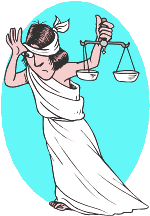
Unlike appeal in a civil case (where appeal can be based only on a trial judge’s materially harmful errors), in a criminal case there are additional grounds for criminal appeal.
The most common grounds for criminal appeal are:
Each of these is discussed below.
Materially Harmful Error
As more fully discussed in the lesson on Appeals (Don't go there yet!) every case, civil or criminal, may be successfully appealed IF:
The process of appealing materially harmful error in a criminal case is essentially the same as that for a civil case and explained in the lesson on Appeals.
Ineffective Assistance of Counsel
The Sixth Amendment guarantee to have a lawyer represent you in a criminal trial includes the right to have a lawyer who knows what he’s doing and does it well. Ineffectiveness of counsel may be grounds for appeal.
There are two general classifications of “ineffectiveness”:
Extrinsic Ineffectiveness
Extrinsic ineffectiveness includes such bone-headed behavior as taking your case without first being at least somewhat familiar with criminal law and procedure.
Failure to properly prepare is another example, as is substance abuse, allowing personal emotions to interfere, or taking on too many cases so individual clients are denied a level of dedicated performance that is professional duty.
Reversal on appeal is rare on this ground, however. The complained of ineffectiveness must amount to something close to a blatant disregard of even the most fundamental professional obligations.
This appellate reluctance even goes to the extreme of forgiving a defense lawyer for conceding the guilt of his client standing trial for murder! Florida v. Nixon, 543 U.S. 175, 190 (20014)
Actual Ineffectiveness
If the defense lawyer commits a material error that’s harmful to your case, you may have grounds for appeal based on the lawyer’s “actual ineffectiveness of counsel”.
Examples include:
Appellate courts evaluate these appeals with a two-part test:
Reversal is also rare on this ground, however appellate courts may find “actual ineffectiveness of counsel” where your lawyer failed to:

In both types of appeal, appellant must show that “but for” the alleged ineffectiveness, the outcome would have been more favorable to the accused.
Otherwise, appeal will fail. The error must adversely affect the “fairness” of the proceedings.
Prosecutorial Misconduct
Prosecutorial misconduct is a leading cause of wrongful conviction.
In most jurisdictions these days, prosecutors are elected by the public. For this reason, some prosecutors tend to be over-zealous, seeking to curry favor with the boss or with voters. They want to win no matter what!

There is always a self-interested motive for prosecutors to skate on thin evidentiary ice and dare operate near the limits of law.
When such a prosecutor crosses the line, you may have grounds for appeal based on prosecutorial misconduct.
“Some wrongful convictions are caused by honest mistakes. But in far too many cases, the very people who are responsible for ensuring truth and justice – law enforcement officials and prosecutors – lose sight of these obligations and instead focus solely on securing convictions.” Innocence Project, Cardozo School of Law.
Some examples that resulted in reversal on appeal are:
New Law
If new law is enacted after conviction, revising or replacing old law so that the accused might not have been convicted if the new law had been enacted sooner, an appeal may succeed if:
New law always applies to pending cases at the time of enactment.
And, of course, new law always applies to new cases after enactment.
But, unless the new law applies retroactively on closed cases, appeal on this ground alone will not succeed.
To apply retroactively, new law may:
Teague v. Lane, 489 U.S. 288, 311, 313 (1989).
New Evidence
If new evidence is discovered that, if presented prior to conviction would have tended to result in acquittal, then an appeal may be taken. If it appears the new evidence would substantially affect the likelihood of conviction, a new trial may be held in some cases.
Probability of Reversal on Appeal
According to the Administrative Office of the U.S. Courts, a mere 5.6% of federal criminal appeals nationwide resulted in reversal in 2007. That may seem a small number when read as a percentage, however when you look at it another way, it’s not so discouraging.
Better than 1 in every 20 convictions is reversed on appeal!
Still, the statistic is daunting to those facing long prison terms or death.
Therefore, as emphasized throughout this course, one should work diligently to do the research necessary to make certain what the controlling authorities have decided already in similar cases regarding issues you feel may be worthy of appellate review.
Conclusion

Being arrested has to be one of the scariest things you can experience … especially if you’re innocent!
Being set free has to be one of the happiest events you can experience! But, being set free depends on knowing what you learned in this class.
The justice system has no magic X-Ray machine to look inside you to “see” your innocence.
The justice system will try it’s dead-level best to prove you are guilty. It will work tirelessly to do so. It will persist in its search for evidence to find you guilty and, if it succeeds, it will sentence you.
Yes, even for crimes you did not commit.
You must understand how the system works before you or a loved one is arrested, what the system must do to get a conviction, what your rights are, what you can do to get a criminal case dismissed or, if you must go to trial, what it takes to persuade the judge and jury to acquit.
What’s offered in this lesson is extremely valuable. It cannot cover the myriad crimes on the books these days nor explain every single tactic needed to avoid conviction, but it has given you a much clearer idea than you had before.
Most people these days know nothing more about our criminal justice system than what they see on TV or at the movies, and what they see falls woefully short of what they need to know about the real world of criminal justice where far too many innocent folks are sentenced (and far too many guilty people go free).
Knowing how to enforce your rights is your #1 Right!
Stay out of jail!

The unauthorized reproduction or distribution of a copyrighted work is illegal.
Criminal copyright infringement, including infringement without monetary gain, is investigated by the FBI and is punishable by fines and federal imprisonment. No portion of this course may be published, duplicated, shared, or used by anyone other than the current subscribers.
© 1997-2025 by Dr. Frederick Graves
d/b/a Jurisdictionary®
All Rights Reserved
866-LAW-EASY ( 866-529-3279 )
19420 Heritage Harbor Parkway
Lutz, Florida 33558
lawbook@jurisdictionary.com
