Objections
Power to Control Judges
“Objection!”
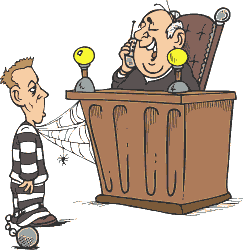
Everything stops when you say, "Objection!".
The judge must deal with your objections. Don't let him ignore you!
He must sustain or overrule your objections. That's his job. That's how you control him. That's how you control everyone in the courtroom. More importantly, that's how you control the record for appeal.
If he says, "Sustained," you get your way.
If he says, "Overruled," you renew your objection and, at the end of the hearing or trial, you renew your objection again! Notice what is said in the sidebar at right. The appellate court needs to see in the record that you gave the trial judge every reasonable opportunity to do the right thing and enforce The Rule of Law. By objecting and re-objecting, you give him ample opportunity to do what he took a solemn oath to do, i.e., enforce the law in his courtroom.
That’s what objections are for. They compel the judge to enforce the rules! They put the judge on notice that you are going to appeal if he rules against you. You learned why this is important in earlier lessons.
Winners know how, when, and why to object. Winners demand that the rules be obeyed and enforced.
Until you master the skill of objecting, you cannot win a contested court battle.
Your failure to object promptly and properly helps your opponent.
Helping Judges
Judges need your help. None of them knows all the law, and many don’t understand the rules!
You must take control.
Make the judge do what he’s being paid to do: enforce the law! That's his job. He isn't paid to make the law. He isn't paid to be the law. He is paid to enforce the law!
If you don’t assert yourself, the judge will sit on the bench, enjoy your opponent’s “smoke and mirrors dog and pony show”, and you will lose.
The judge is not required to interfere!
If a judge interferes, object (unless his interference is helping you and not your opponent). Judges are paid to referee the contest, not to help the players. Your objections call their attention to foul plays.
Judges aren’t as smart as we’re taught to believe. Every one of them is a mortal human being. They have feelings, opinions, and biases just like the rest of us. The vast majority of judges I appeared before were excellent people, but I ran into a few who were outright scoundrels. Don’t fall into the trap of thinking the judge is "smarter" than you. He's probably smarter about some things, but you are smarter about other things. Control him! Make him do his job!
You might get a judge who thinks he is “the law”. I met only one and had the appellate court teach him a lesson by reversing him on appeal. Most are hard-working, community-conscious individuals who will do what the law requires if you control them with your objections.
Do not object if it won’t help your case! Objecting to hear yourself say that imposing word that you heard TV actors say in court dramas will gain you nothing. It will anger the judge. It will pollute the record with useless stuff. It will show that you didn't study this lesson and don't really know what you’re doing. It may show the court that you don't deserve to win!
But, if you don’t object, no fouls will be called!
Object surgically! Object tactically! Object effectively! Force the judge to do what’s right!
Well-stated objections can win otherwise unwinnable cases.
Instruct the court!
Renewing Objections

When an objection is overruled, renew it. Say, “Objection renewed,” or words to that effect.
Some jurisdictions don’t require it, but I recommend it, because it gives the judge one last chance to do what’s right. When the appellate court sees that you tried to correct the judge by renewing your objection and that the judge ignored you, the higher court will take a closer look at the record and possibly decide to reverse the judge so you win on appeal then and there, or it may send the case back down to the trial judge instructing him to obey the law!
A judge may say, “So noted,” when you renew an objection. That's ok. It will be in the record.
The dynamic force of objections cannot be over emphasized.
Controlling the judge cannot be over emphasized.
Winning is all about preparing for possible appeal.
It is not about "persuading" the judge. It is not about fancy language. It is not about entertaining or impressing the jury.
It's about preparing for possible appeal!
In a nation where The Rule of Law is secured by a system of rules that secure due process for everyone, you have power to get Justice for yourself and those you love if you learn these things!
Common Sense
Lawsuits are not a hockey game. On the ice a player’s bitter have no effect on hardened referees. Angry hockey players can bitch and moan until they get benched. The referee rules. That’s the end of it!
In court your objections immediately command the “referee” who must immediately rule. He may sustain or overrule, but he cannot ignore.
Most judges listen to objections, consider carefully before ruling, and will reverse themselves when you renew your objections if you persuade them that they should have sustained in the first place.
But not all judges are paying attention. You may notice the judge fiddling with his laptop, staring out the window, or chatting with his clerk while you’re struggling to make points critical to your case. I caught one reading a newspaper and got his attention by saying, “Objection! Let the record reflect that the judge is reading a newspaper instead of paying attention to this hearing!”
Yes, you can do this. Use your common-sense!
If something other than “speech” happens in court (finger pointing, threatening facial gestures, or any non-verbal gesture or action that communicates but cannot be recorded, OBJECT. "Let the record reflect that opposing counsel is pointing a pencil at my witness!" Tell the record what's happening. I won many cases making the record show judges, lawyers, and witnesses communicating non-verbally.
If you want Justice, fight for it!
If you must embarass someone to win your case, embarrass them!
Do not be afraid of the judge! Be polite but forceful. It’s how winners win.
Pull no punches! Justice doesn’t grow on trees.
You have to fight for Justice. This is how you fight.
If the judge isn’t looking at you, he probably isn’t listening either. Get and hold his attention when you speak. Make eye-contact. Keep eye-contact. Don't be shy!
It’s your lawsuit … not his. Judges go home at the end of the day, whether you win or lose. Your life will change. His life remains the same.
Don’t be timid. Toss a red flag every time the judge or your opponent commits a foul.
Use common-sense in addition to the rules of court.
When a hockey game is over, the game is over.
When a court case is over, the consequence can last a lifetime.
Preparing for Appeal
Winning is all about preparing for appeal. There! It's said it again! It needs to be said again and again and again and again!
Good lawyers who make a name for themselves by winning consistently know this and do what this course teaches. Losers nonchalantly muddle through, believing they can always appeal if they lose.
You get no second bite at the judicial apple if your first bite in the trial court doesn’t succeed and you failed to make the record for a successful appeal.
Winners constantly, persistently, and intensely work to make the record clearly show when the judge allows even the slightest error that might affect the outcome of their case. They don’t care if the judge gets angry. They will go to the mat with the judge and run the risk of being jailed for contempt if that’s what it takes to get Justice for their clients. They do not kow-tow nor apologize!
I've known timid lawyers afraid to upset the judge. They cheated their clients by allowing opportunities for victory fly past without objecting or moving for an order to strike inadmissible evidence. They thought they must “please the judge”. They feared being held in contempt. They were foolish. They were losers.
Pleasing judges doesn’t win court cases. Getting evidence and objections into the court record wins legal battles, and that is done by forcing judges to do what’s right … whether they like it or not!
Lawyers who won’t fight should be greeting people at Walmart, instead of robbing their clients.
This may seem repetitive. It is repetitive. It needs to be repeated!
The Importance of Objections
The U.S. Supreme Court said in an appeal questioning the Miranda warning police must give before they can question suspects about an alleged crime, “In the Miranda case this Court promulgated a set of safeguards to protect the constitutional rights of persons subjected to custodial police interrogation. The Court held that unless law enforcement officers give specified warnings before questioning a person in custody and follow specified procedures during the course of interrogation, any statement made by the person in custody cannot, over his objection, be admitted in evidence against him at trial.” Michigan v. Tucker, 417 U.S. 433, 443 (1974).
Objections are essential both before and during court proceedings.
Failure to object can be fatal!
Failure to object promptly may waive your right to object later.
If you aren’t sure, object anyway!
When to Object

If something sounds fishy, object at once!
If you don’t know the "grounds" for your objection, object anyway!
It's best if you can state effective grounds for your objections, but if you cannot think of them at the moment, it’s better to object without them than never to object at all.
If your opponent asks a witness, “What did your boss say was the reason he was firing you?” immediately jump to your feet with “Objection! Hearsay!” Do not let the witness speak before you object! If you allow the witness to answer that question before you object to stop everything in its tracks (as you learned earlier in this lesson) the witness will answer. Inadmissible hearsay will come in. The recored will show it. The jury will hear it. The jury will not un-hear it. And it could cost you what was otherwise a winnable case!
If you sit there trying to remember the grounds for your objection, while the witness tells jurors what his boss may or may not have said (witnesses lie) you cannot go back and erase that testimony. You can challenge it on cross-examination, but you can't erase it.
You could have stopped it before the jury heard a word of it.
You could have bravely shouted out, “Objection, your Honor!”
The opposing lawyer would be silenced, and the judge would ask, “On what ground?” By then you might have come to your senses and remembered the evidence rule that forbids hearsay testimony. But, if you don't jump and object at once, the cat will be out of the bag.
As said before, you can’t unring a bell.
Juries can’t un-hear testimony.
Objecting too late is too late!
Grounds for Objections
The most common grounds for objections are evidence rule violations, and you already learned what the evidence rules allow and what they do not allow! Other grounds are procedural rule violations (you'll learn more about these in a later lesson), general law violations, civility rules, and common-sense,
When you know by heart the rules that are designed to control the judge and your opponet, you can back up your objections, compel judges to sustain your objections, and preserve your record for the appellate court to see clearly what kind of games were being played in the lower court if appeal becomes necessary.
Some objections are so obvious from the context of what's happening at the time that the judge may not require grounds and will sustain those objections without another word from you. But, if your opponent has a brain in his head he will demand that you state them. Once your opponent demands them, of course, the court must require you to state what they are, or your objection will be overruled and fail of its purpose.
If the judge asks and you can’t remember say simply, “I can’t think right now, your Honor, but I want my objection on the record anyway!” That’s better than nothing. It may not get what you want at the moment, but it could save your bacon on appeal if the error was so obvious that the appellate court would find fault with the judge for not intervening in the interest of Justice.
It is always better to object, even without grounds, than to let a material error slip through without there being some notice of it in the record.
When Not to Object
If an objection is not going to favor your case, don’t object!
There will be times (at depositions, hearings, and at trial) when your opponent asks a leading question of his own witness (an objectionable offense as you learned earlier). You could object. But why do so?
There may be situations where you want the court to hear testimony in response to your opponent's questions. Maybe the answers won’t hurt your case. Maybe they will help!
Never object just to worry your opponent. That will work against you!
Object only if the testimony will hurt you.
Don’t wear out your objections. They are tools like all the other tools you are learning in this course.
Use objections wisely and only when needed.
Putting Objections to Work
Imagine you’re trying a case on the single issue of whether a surgeon removed someone’s kidney. You represent Dr. Cutsum Good, a surgeon being sued for medical malpractice.
Opposing counsel clears his throat impressively, and calls his first witness: Miss Makesumwell, a recovery room nurse. “You’re a recovery room nurse?” he proudly asks, leaning confidentially closer to the witness.
“You know that already. I told you that last week when you interviewed me at your office.”
“Tell the court, young lady, what the operating room supervising nurse said after Dr. Cutsum finished surgery.” (Did you object in time to prevent the hearsay testimony?)
Nervously, the nurse replies, “She said the patient’s kidney was too cancerous to remove.” (Did you move the court to strike the answer and instruct the jury to disregard, which they cannot do anymore than you can disregard the nose on your face.)
“Dr. Cutsum didn’t remove the kidney?” your opposing lawyer continues. (Did you catch that objection? Miss Makesumwell works in the recovery room, not the operating room. How could she know other than by hearsay? Stay on your toes! Listen to what is being said. Drink lots of coffee.)
“No, sir,” she replies while you are thinking about the parking meter.
“Please tell the court," the lawyer continues to win his case without your interrupting, "what Dr. Cutsum was thinking by leaving that cancerous kidney inside Mr. Sickman’s body that day." (What can that nurse know about what someone else was "thinking"? You are losing the case while you think about what you’re going to ask the witness when it’s your turn. You should have stopped this question before it was finished. It calls for objectionable speculation, as you’re about to learn in this lesson.
“He probably thought Mr. Sickman was going to die anyway,” the nurse answers, as your case circles the drain. “Dr. Cutsum isn’t respected at our hospital. He makes all kinds of mistakes. Several operating room nurses refuse to work with him.”
The nurse continues while you shuffle papers.
Do you see the irreparable harm you allow by not objecting intensely, instantly, and imperatively?
Let’s review.
Hearsay
The nurse should not be permitted to say what her supervisor said, if what the supervisor said is offered to prove the kidney was not removed. That’s an out-of-court statement by someone not in court and offered to prove the truth of what was said. (Go back to the evidence lesson if you missed this.)
Competence
Recovery room nurses can have no first-hand knowledge of what goes on in the operating room. She lacks competence to say whether a kidney was removed or not.
Calls for Speculation
The rules forbid testimony about what someone else thinks or feels. Nobody knows. A witness may testify about first-hand observation of facial expressions, body language, or other behavior, but not what's inside another person's mind.
Once these cats are out of the bag, it is too late to put them back.
If you are questioned, count to ten before answering. If your witness will be questioned, tell your witness to count to ten before answering. If your opponent's witness is being questioned, intensely pay attention to every word coming out of your opponents mouth and object immediately upon sensing that his questions seek damaging testimony. Do not let his witness speak!
Once a witness starts testifying as to privileged facts without a timely objection stopping it, the court may even rule that the right to object has been waived! No appeal can cure such errors.
“The requirement of a contemporaneous objection [made at the time of error or as closely thereafter as possible under the circumstances] is based on practical necessity and basic fairness. It puts trial judges on notice that an error may have been committed. It provides him an opportunity to correct the error at an early stage of proceedings. Delay and unnecessary use of appellate process result from failure to promptly cure early what must be cured eventually.” Calhoun v. State, 721 So.2d 1180 (Fla. 1st DCA 1998).
The U.S. Supreme Court said, “The contemporaneous-objection requirement serves a well-recognized and legitimate state interest by avoiding flawed trials and minimizing costly re-trials.” Smith v. Texas, 05-11304 (U.S. 4-25-2007).
If you fail to object promptly, the appellate court may refuse to hear your appeal altogether.
Timeliness is everything!
Objections at Depositions
In many jurisdictions litigators may not state objection grounds at depositions. They may say “Object to the form,” or something similar, getting their objection into the record without specifically stating grounds.
There’s no judge at depositions, so there’s nobody to rule on your objections. But, when it’s your turn to object, state your grounds! If the opposing lawyer tells you that’s improper, ignore him!
State your grounds!
Some jurisdictions allow parties to argue grounds at a separate hearing before a judge, but this is clumsy and likely to lead to foreseeable problems, because lawyers are tempted to lie and do lie.
Make the grounds for all your objections clear on the deposition record just as you must make them clear on the record at a hearing or trial! Your opponent’s convenience or traditional way of doing things should be ignored. Unless the official rules in your jurisdiction specifically forbid it, state your grounds for all objections at all times – depositions, hearings, and trial. That way the record is kept secure.
If opposing counsel drums pencils, leans too close to the witness, makes threatening faces, or in any way interferes with your right to a fair and civil deposition, simply say to the stenographer, “Let the record reflect that opposing counsel is making outlandish threatening faces, drumming his pencil menacingly on the table, and intimidating my witness.” You won’t make friends, but you’re not there to make friends.
If the nonsense doesn’t stop, terminate the deposition by saying, “Let the record reflect this deposition is herewith terminated. I will be motioning the court for an order re-setting this deposition at a later time after my opponent has been instructed by the how to behave himself at depositions.”
It may be enough to merely threaten to terminate and see a judge but, if it isn't, follow through! File the written motion, set it for hearing, and attend with a transcript that shows clearly the games your opponent was playing to unjustly get an advantage.
Expect nonsense! It's commonplace!
Stop it in its tracks!
Renewing Objections
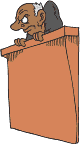
This, too, was covered earlier, but it is so very important we need to take a closer look.
Anger the judge if you must! Let him fume and snort and stew and bang his gavel and glower at you with a menacing stare ... but do not cave in!
If you don’t have to anger the judge, of course, be nice. Always be polite. Be a gentleperson.
But, if your objections are overruled, renew them!
Failure to fight will cost you your case and impact your future and the future of people you love.
In addition to renewing objections immediately after they are overruled, here are others times when renewing them is recommended:
Renewing gives the judge a clear, unquestionable opportunity to reconsider his prior rulings. That makes you and your case look good to the appellate if you lose and must appeal. Carratelli v. State, 915 So.2d 1256 (Fla. 2005).
Failure to object or renew during trial waives your right to object for the first time on appeal.
This is not a parlor game! If renewing objections angers the judge, let the judge be angry. You have a right to make your record. You are inviting defeat if you refuse.
The judge may turn surly. He may threaten you. He may tell you to stop.
One student of this amazing court reported that a judge told him to “Shut up!”
If your judge is having a personal problem, get it in the record for the appellate tribunal to see!
Judicial errors are the sole basis for appeals. You cannot appeal just because you lose. You must show in the record that the judge made material errors. Never forget this!
Preserve the record. It is your record. It is your only chance to win if the judge allows errors.
When a Judge Won’t Rule
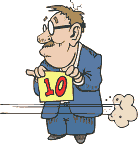
If the judge refuses to sustain or overrule your objection, move him to do so! Say, “I move the court to rule on my objection.”
Suppose opposing counsel asks his witness a leading question, “Isn’t it a fact you were standing on the corner of Main and Elm at 2:30 on the day of the accident?”
“Objection. Leading,” you chime in. The judge says nothing. The witness goes ahead and answers the leading question. If you do nothing more, your objection may be rendered worthless. You must assert yourself. Move the judge to rule! Stand up for Justice! Do not be afraid of the judge! Do what you must to make the record for successful appeal. It will be too late if you don’t do it immediately!
Judges are paid by your tax dollars. They have a job to do. If you do not force them to do it, they may sit back, earn their salaries, and do as little as possible … while your case goes down the tubes.
Give your objections teeth!
Don’t let your case proceed until the referee in the black robe rules on your objections!
Move him!
Make the record show he is in violation!
Objection Classifications
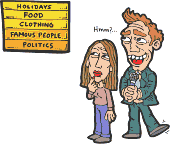
Objections fall into four categories.
Evidence Rule Violations
If your opponent asks a witness, “What did the taxi driver say when you told him to ‘step on it!’?” … you already know to jump up with a hearsay objection.
The same applies when any evidence rule is violated or so much as an attempt is made to violate.
Cut your opponents off at the knee! Drive a nail in their heads! Memorize the official evidence rules in your jurisdiction and prepare for battle!
Study the foregoing evidence lesson several times so you are familiar with what to do when your opponent or the judge gets out of line!
Memorize the rule numbers in your local evidence code. The federal rule against hearsay is Rule 802. That’s one you can remember. The numbers may be different in state court, but you can memorize at least the most important ones you’re likely to encounter.
Then, when you smell a rotten evidence apple, you’ll be quick to your feet with grounds and the official rule numbers for your objections.
Procedural Rule Violations
Any time a party or judge permits an action that's forbidden by the Rules of Procedure, object!
If plaintiff moves for an order setting a trial date at the beginning of a case, and your motion to dismiss has not yet been heard, object! If your motion to dismiss succeeds, the case will be over, with no need for a trial. Procedural rules forbid setting a trial date until “all motions directed to the pleadings” have been disposed of.
If you don’t object you could be dragged into a down-and-dirty trial with your procedural due process rights ignored.
Any time a procedural rule is violated or threatened to be violated, object!
Make your record for appeal or be unable to appeal.
General Law Violations
If a party or judge violates an ordinance, statute, appellate court decision, or any provision of controlling law whatsoever, object! State what the law is and how it’s been violated. State it on the record.
If a party claims documents you want to see contain trade secrets, for example, you have a right to have the judge examine those documents to see if they do, in fact, contain trade secrets. That’s the law. If the judge refuses, object, and get it on the record.
Do the same no matter what law is violated or threatened to be violated.
Preserve errors for successful appeal by objecting.
Civility and Common-Sense Violations
If your opponent’s lawyer wears a wide necktie prominently emblazoned with a brightly colored depiction of a young woman wearing nothing but a smile, object! “Objection! Let the record reflect that opposing counsel’s necktie is, shall we say, distracting!” Get it on the record!
Civility and common-sense are unwritten rules of court. There’s nothing in the rules about neckties, but if a necktie or anything else is likely to divert the course of justice, object!
Court is not a side-show or comedy club. If anything seems out-of-sorts, unusual, rude or intimidating, or otherwise impolite or disruptive, object! Baseball caps and Grateful Dead t-shirts are grounds for objection. Object to get it on the record.
Judges must apply the rules of evidence, rules of procedure, and provisions of law so their courtrooms can get to the Truth and administer Justice without distractions, but they must also enforce the unwritten code of common decency and respect for The Rule of Law and the rights of others to be free from disruptive interference.
Don’t let your judge be ringmaster in a three-ring circus.
Object!
Argumentative
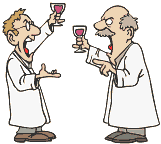
This objection is proper when a party asks a witness questions with intent to start an argument.
Witnesses are called to answer questions. They are not there to engage in combat. If your opponent asks a question that is not reasonably calculated to lead to the discovery of admissible fact evidence but serves only to argue his case or create unnecessary controversy, say, “Objection! Argumentative!”
Opposing addresses a witness with, “Admit that your earlier testimony about a banana peel on the grocery store floor wasn’t the truth.” This is argumentative. The witness already answered. A different approach might be used to get the witness to admit a mistake, but not a direct attack on his character.
If argument is attempted to discredit a witness, object! If your opponent tries to get a witness to lose his temper, object! If your opponent is badgering for badgering’s sake, object!
Keep your opponent from doing anything other than presenting factual evidence and the law that requires the judge to grant Justice.
Asked & Answered

Suppose your opponent asks, “Did you witness the accident?”
The witness answers, “Yes”.
Your opponent asks, “Did you see the cars collide?”
The witness answers, “Yes.”
“Are you certain the cars crashed into each other?”
Again the witness says, “Yes.”
“Did the car crash take place while you were present?”
Nip that nonsense in the bud with, “Objection! Asked and answered!” Once is enough. Twice is more than enough. Three times should always trigger this objection. Four times and you’ve fallen asleep at the switch and given your opponent an unnecessary advantage!
You will encounter this. Lawyers will dwell on a single topic. They will hammer a point. They will get witnesses to examine a single thing from all possible angles and in the minutest details ad nauseum. Don’t put up with it! It is done to emphasize adverse testimony. It may seem innocent at first. You may not notice it the second time. The questions weren’t the same. The answers were different each time. But, your opponent is doing it on purpose.
Stop it before jurors think your opponent has more evidence than he actually has, that you don’t have as much “evidence” on your side. The jurors will think, “Listen to all that evidence this witness is giving!” when, in fact, it’s just different questions seeking the same answer over and over again.
Good judges will sustain your "asked and answered" objection and order your opponent to, “Move on!”
Rule 403 of the Federal Rules of Evidence prohibits any evidence, including relevant evidence, if it wastes time, misleads the jury, causes unnecessary delay, or “needlessly presents cumulative evidence”. Your state rules follow the federal rules. It is objectionable!
Don’t let it happen to you!
Badgering
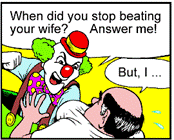
Insults and intimidation are not allowed, because they are not aimed at getting evidence. They are aimed at confusing or embarrassing witnesses, hiding evidence, and evading Justice.
If your opponent attacks a witness with, “Admit it! You don’t really care who you hurt with your editorials in the newspaper," stand to your feet and say, "Objection. Counsel is badgering the witness. He is not trying to get any evidence with regard to any issue raised by the pleadings. He is simply trying to discredit this witness and confuse the jury as to what this case is really about."
Anything that is not reasonably calculated to lead to obtaining evidence relevant to the issues raised by the pleadings in a case is out of bounds. Badgering is one of those things that is out of bounds.
There will be times when you need to play hard-ball, squeezing answers from a witness who doesn't want to say what you need him to say. But, be nice! You catch more flies with honey. If you back them into a corner like frightened animals, they will resist you. Smile. Be cool. Put witnesses at ease when you can.
But, if a witness “clams up”, hiding something you need him to say, switch to offensive mode and dig into him with probing and possibly embarrassing questions, but do not badger! Badgering makes you look like the bad guy. Jurors are sensitive. Jurors pick up on your demeanor. If they don't like you, they may end up liking your opponent ... no matter what the evidence proves!
Dramatic actors posing as lawyers do it. It will backfire on you. Your case is too important to imitate what actors do on TV.
If your opponent badgers a witness, object. But, if his cruelty helps your case, let him badger all he wants. The jury is watching!
Best Evidence Rule

Rule 1002 of the Federal Rules of Evidence says an “original” is required to prove content of documents, recordings, photographs, and similar things.
This is the “Best Evidence Rule”.
If your opponent brings copies to court instead of originals, and if making him produce originals will help your case, say, "Objection. Best evidence rule."
Suppose your opponent offers an alleged copy of a cancelled check to prove his client paid some bill you claim is still due and owing.
“Objection! Best evidence rule.”
Before the judge rules on your objection, he should ask your opponent, “Where is the original?”
If the other side replies, “It’s in the safe at my office,” don’t roll over and play dead. Insist on the original as this rules requires when the original can be obtained!
If the other side claims, “The original was destroyed,” demand that they tell the court how and why the original was destroyed.
Also read Rule 1004 of the Federal Rules of Evidence that allows a copy if and only if:
Common-sense and fair to both sides.
Copies are easily forged. Even if copies are allowed to be produced, they never carry the same probative weight as originals. Jurors aren’t stupid.
In the case of security instruments and negotiable paper (e.g., promissory notes, bonds, stock certificates, etc.) a copy is worthless except to show what the original “may” have looked like or said. You can’t spend a copy of a dollar bill. Copies of promissory notes, bonds, and stock certificates are worthless paper.
If the original is not available and the court admits a copy, remind the jury that a copy is never the same as an original. It can be a forgery. With today's technology a school child can use a computer and printer to create what appears to be an original document. Artificial intelligence will do it even easier!
Beware of copies. The best evidence rule will prevent the fraud of forged copies … only if you object!
The U.S. Supreme Court said, “The elementary wisdom of the best evidence rule rests on the fact that the [original] document is a more reliable, complete, and accurate source of information as to its contents and meaning.” Gordon v. United States, 344 U.S. 414 (1953).
If an original can be produced, it must be produced.
Speaks for Itself
If opposing counsel asks a witness to say what some document says, say, "Objection. The document speaks for itself.”
Do not let witnesses say what a document says (unless it will work in your favor).
The document may be offered and admitted into evidence. It may be read by a witness (if a copy has been provided to you first so you can follow along), but the witness cannot tell the court what a document "says" unless you do not object.
Much of the evidentiary process in court is based on what documents say. A witness might explain some provision in a document, but we need the document to tell us what it says, not a witness who can lie as witnesses all too frequently do.
If opposing counsel asks a witness, "What did Aunt Suzy's letter say," of course, then the first objection is hearsay (unless the letter has been admitted into evidence and marked as an exhibit), and the second objection is, "The document can speak for itself. Where is that document, by the way?"
Moreover, the original is required (with the four exceptions listed above). The could should never permit a witness to tell the court what a document says, especially if the document has not been produced.
Competence

As you learned a bit about earlier, witnesses must have first-hand knowledge of the facts they allege on the stand and, moreover, they must possess sufficient mental capacity to understand the questions and their answers. Otherwise the witness and the testimony lack competence.
"Objection. Competence."
Any witness who did not see or hear or otherwise experience first-hand the things he is being questioned about is incompetent to testify.
Expert witnesses can offer opinions about hypothetical facts without having first-hand knowledge. However, expert testimony is always opinion, not fact. Lay witnesses must always have first-hand knowledge of the facts they allege on the stand.
Any person formally adjudicated senile or insane (e.g., committed to an institution for mental infirmity or placed under court-ordered guardianship) lacks competence to testify.
The same applies to persons using mind or mood altering medication (prescribed or illegal). That's why you learned earlier to question them about whether they've taken any medications or mind-altering drugs in the past 24 hours and if they are under the influence of alcohol before going into the main part of your interrogation. You’ll usually get a quick denial but, if they admit it, move the court to recuse them from the case. If the court refuses, object. If the court overrules your objection, object again!
Children usually lack competence to testify in court. The child’s age comes into play. If you think a child witness should take the stand in favor of your case, do some research to determine at what age the law says a child may be competent to testify. What’s too young in one case may be old enough in another. A high school honors student might be allowed to testify while a three-year-old most certainly would not.
Lawyers will try to elicit testimony from witnesses who have no first-hand knowledge. In some cases the lawyer may know the witness is in-competent to testify yet try to use them anyway. Don't trust lawyers! Expect them to do all they can to pull evidentiary rabbits out of invisible hats, because they will.
If this objection is overruled and overruled again when you restate it, wait until your opponent finishes with the witness then cross-examine the witness to show the jurors how limited the witness’s knowledge truly was and why the witness testimony should be given no weight at all in their deliberations.
Physical Competence
In the hilarious movie My Cousin Vinny, an old lady testifies that she saw, from the front window of her living room, two young men robbing a convenience store across the street. The defense lawyer had not yet passed the bar. His name was Vinny, played by Joe Pesci.
The old lady insisted that the boys she saw were Vinny’s cousin and a friend, so Vinny stretched a measuring tape from the witness box to the back of the courtroom then challenged the old girl to tell how many fingers he was holding up. She couldn’t see through her thick bifocals and could not possibly have identified the two boys at the distance she claimed.
She lacked physical competence, as would a witness bound to a wheelchair who testified that he could stand, or an inmate locked in a prison cell who insists his clairvoyant powers let him "see" a crime being committed on the other side of town.
Don’t get blind-sided!
Counsel Testifying
All lawyer testimony is inadmissible.
They will do it if you don't stop them with, "Objection. Counsel is testifying. He lacks competence to tell the court facts about which he has no first-hand knowledge.:
Lawyers are allowed to offer documents and other things as evidence. They are allowed to ask questions of witnesses about those documents and things and about anything the witnesses know about facts relevant to the issues raised by the pleadings.
They are not allowed to testify ... unless you let them!
Judges will not stop them.
When the opposing lawyer starts doing this, as he undoubtedly will during your case, make this objection and, if the court overrules your objection (and you renew it) move the court to have the lawyer sworn (i.e., placed under oath subject to penalties for perjury) and to be required to submit to your cross-examination.
That's how one gets to the truth in court, not by letting lawyers tell the court what the facts are.
If that fails, the move the court to require the lawyer to call witnesses or present documents or things in support of his testimony.
If that fails, you've made the record for a successful appeal.
Lawyers know nothing beyond facts they learn from clients or third persons they interview. They lack competence to testify about anything! They can talk about the law, but they cannot testify about facts!
If you allow it you will lose … needlessly!
Facts Not in Evidence

Lawyers often try to “remind” the court about facts that have not yet been introduced and admitted into evidence or even facts the lawyer knows do not exist. Yes, some of them are this crooked. They will try to sneak facts into the record when there is nothing to support those facts, no documents, no exhibits, no witness testimony, nothing but sneaky wordwork!
“Objection! Facts not in evidence!”
You’ll find it in written motions, memoranda, notices, and even in orders that lawyers may be allowed to prepare for the judge to sign at the close of a hearing … orders alleging facts that never existed!
Stop it by objecting.
The judge won’t stop it for you, and telling the jury to “Disregard counsel's last statement,” is an empty gesture, as you've already learned. You must object quickly … before the jury hear what the sneaky lawyer tries to get them to hear.
Lawyers will try to get witnesses to testify about things for which there is absolutely no foundation in truth, no facts in evidence, nothing! Good judges will sustain this objection and tell the lawyer to stick to the facts in evidence."
Imagine you’re accused of stealing paint from plaintiff’s warehouse. The plaintiff’s lawyer wants the jury to think his client would lie about your stealing his paint, so he asks a witness, “Wasn’t my client volunteering at his church’s soup kitchen when you noticed the paint was gone?”
There are no facts in evidence about a soup kitchen or plaintiff’s angelic volunteerism. Object! The lawyer is trying to make his client look good.
If the witness testified earlier that he saw you load paint on your truck, it's perfectly permissible to remind the court about that testimony. “The court will the previous witness recall seeing the defendant putting paint on his truck." But, what if the former witness did not say that?
This happens! Be prepared.
“Objection. Facts not in evidence.”
Hearsay

Rumors are not reliable. You learned this in the Evidence class. With few exceptions, what was said outside court by someone not in court where they can be cross-examined is inadmissible if offered by a witness in court to prove that what the outside person said is true.
Many lawyers and even some judge's don't understand this.
Hearsay is inadmissible!
When you hear, “What did Mr. Jones say … “, object immediately! If Mr. Jones is not in court, the witness testimony your opinion is digging for can only be hearsay. This applies at hearings, depositions, and at trial.
Sleazy lawyers will ask, “When you were working on that flimsy ladder on the north side of the building just before you fell, did you look down to see if you left your paintbrush on the ground, and did Mr. Jones say anything?“ See how the lawyer tried to get the hearsay past you by burying it in another question?
You must prevent hearsay before it comes in.
"Objection! Hearsay! Let counsel bring Mr. Jones to court so I can cross-examine him!"
Lawyers will do their best to get hearsay in when they have no witnesses, no documents, and nothing else to support the allegations in their pleadings. Don't allow it. Control the court!
Outside the Pleadings

A young lawyer at a hearing some years ago attempted to raise a new issue against my client, something he failed to include in his pleadings.
“Objection. Outside the pleadings!”
The judge looked at me approvingly and said, “Sustained!” My client won the case!
The young lawyer forgot to raise that issue at the beginning of his case against my client, and the rules do not allow that sort of thing. What the pleadings say are issues at the beginning of a case (You will learn more about pleadings in a later lesson.) are what the issues are througout the case. They can only be changed by amending the pleadings, and that cannot be done once the pleadings are closed.
Once all motions directed to the pleadings have been ruled upon, the pleadings are “closed”. No new issues can be raised or litigated … unless you are asleep at the switch and fail to object.
Read the pleadings in your case (complaint, answer, affirmative defenses, counterclaims, cross-claims, and any third-party complaints in civil cases; warrants and charging instruments in criminal cases). Know what the issues are that must be litigated. Know what you are fighting about. All issues must be alleged in the parties’ pleadings. This sets up the game at the start so the fight is fair, with no last minute ambushes!
Keep the fight over issues raised by the pleadings!
Prejudice

Prejudice unjustly tips the scales of Justice. It casts things in a bad light. It isn’t fair, and it isn’t allowed, unless you fail to object to keep it out.
The word comes from Latin “pre” and “judice” … to pre-judge, i.e., to get the court to judge before or in spite of admissible evidence.
All admissible evidence has a “probative value”, i.e., the tendency to prove that some fact is true, but some evidence is inadmissible because its “prejudicial value” tends to shock, confuse, or mislead.
Evidence may be relevant yet not be admissible if its prejudicial value outweighs its probative value.
For example, gruesome bloody photographs of accident victims are not necessary to decide who caused the accident. They might be probative of the extent of injuries and admissible if the extent of injuries is a disputed issue, but if their shock value outweighs their probative value, say, "Objection! Prejudicial!"
Testimony of a physical therapist describing the impairment an injured person and how it is likely to cause that person to suffer in the future is admissible evidence, but unnecessarily bloody photographs are not.
If you know in advance that your opponent plans to introduce prejudicial evidence, a Motion in Limine should be filed before the hearing or trial to keep it out. (More in the lesson on Motions & Hearings.)
Don't let prejudicial evidence come in. Object!
Qualification of Witnesses
Lay witnesses cannot give expert testimony. Experts cannot give lay testimony. You learned the difference in the foregoing lesson on evidence.
If a lay witness is asked to offer an opinion say, “Objection! This witness is not an expert! He can tell the court facts about which he has first-hand knowledge, but his opinions are not relevant.”
If an expert is asked to testify about a fact say, “Objection! This witness lacks competence to testify about the facts in this case. He can offer opinions about hypotheticals but must not testify as to the facts.” Before an expert can testify, the court must examine his special skill, education, or advanced training to see if he is competent him to offer such opinions. Both sides are given an opportunity to voir dire the proposed expert (independently interrogate) with regard to his alleged qualifications, and the court may then deem them to be experts in the field of testimony they are being called upon to give.Experts may never offer an opinion as to who should win a case.
Lay witnesses may offer opinions based on personal knowledge if their opinions are “rationally based on perception and helpful to a determination of a fact in issue.” Lloyd v. American Airlines, 537 U.S. 974 (2002). It is allowed if it will be “helpful to determination of a fact in issue”. It is not allowed if the lay opinion relies on special skill, education, or advanced training.
If your opponent asks an expert witness to offer an opinion outside the scope of his qualifications or to testify about facts in the case for which he has no first-hand knowledge, object!
If your opponent asks a lay witness, “Did your Grandmother have a brain tumor?”, object! The lay witness may say, “There’s been something wrong with Grandmother since she fell and hit her head.” That testimony does not require medical expertise. It only states facts within the witness’ first-hand knowledge.
What a lay witness thinks happened is objectionable. What a lay witness was told about what happened is objectionable. What a lay witness personally observed is not. Lay witnesses do not have special education, training, or experience.
Don’t let an expert witnesses give lay testimony. Expert witnesses do not have (should not have) first-hand knowledge of the facts of the case.
Don’t let lay witnesses give expert testimony nor lay witnesses give expert testimony.
Object!
Relevance

Relevance is the #1 filter. Irrelevant testimony is inadmissible. Keep it out!
To be relevant, as you already learned, it must tend to prove or disprove a material fact, i.e., a fact that can affect the outcome of the case, i.e., a "dispositive" fact, one that can dispose of an issue raised in the pleadings.
If your opponent tries to introduce facts that have nothing to do with any issue in your case, object! It is done to confuse the court and waste time. “Objection! Relevance!”
Facts in controversy are alleged by the pleadings. Anything not alleged in the pleadings is irrelevant unless it is reasonably calculated to lead to admissible evidence.
Whether Uncle Marty earned the Eagle Scout badge as a Boy Scout might tend to prove he is trustworthy, loyal, helpful, courteous, etc. His Boy Scout accomplishments, however, are not relevant in a case where a child’s death or injury resulted from Uncle Marty’s driving a cement truck while blind drunk.
Stop it before it comes in.
My opponent tried to drag my client into a friendly chat during a deposition, talking about how the lawyer’s grandmother made brownies. That lawyer and my client began to get "friendly", talking about recipes, instead of sticking to facts material to the case. Then in an instant the lawyer slipped in a question that would have damaging consequences. I stopped him with, "Objection. Relevance." The case had nothing to do with baking or grandmothers. That lawyer hoped by chatting about innocent matters he could drag my client into thinking he was a nice young man who loved his granny. He wasn’t a nice young man! He was a bank’s highly paid lawyer. His only thought was to save the bank’s money and earn a hefty fee for himself!
If your opponent starts chatting with a witness about irrelevant matters, pay extreme attention, because he is going to sneak in an impermissible question to get inadmissible evidence into the record.
Stay on your toes. Relevance objections win legal battles!
Speculation

If your opponent asks, “What was the doctor thinking?” or, "Was the victim happy?", object!
Such questions happen all the time. Lawyers use them, in spite of the rules, to influence the court about facts that witnesses cannot know.
“Objection! Calls for speculation!”
As stated many times before (because it is so vitally important for you to remember) you must stay alert. You must be prepared to instantly object. These questions will be asked by your opponent. They can turn the jury against you!
Don’t daydream or plan questions you intend to ask when it’s your turn. Pay attention. Sneaky questions come like snakes in tall grass. There will be no warning. If you aren’t quick with objections, witnesses will give testimony you don’t want the court to hear.
“When the doctor snapped off his rubber gloves and tossed them in the trash, was he worried?"
Who knows?
Object!
Conclusion
Millions fought and sacrificed their lives to secure your right to enforce rules and control judges.
Too many of you are suffering because nobody told you about those rules or how to use them to control judges and get Justice for yourselves and those you love.
Now you know how to fight!
What's gone before in this valuable course has empowered you to enforce the rules and control judges.
In the lessons that follow you will learn about how to present issues for the courts to adjudicate, how to find the law that controls the courts' decision, and how simple it all can be when you take the legal process apart and examine it step-by-step.
None of it is rocket science.
Tell others!

The unauthorized reproduction or distribution of a copyrighted work is illegal.
Criminal copyright infringement, including infringement without monetary gain, is investigated by the FBI and is punishable by fines and federal imprisonment. No portion of this course may be published, duplicated, shared, or used by anyone other than the current subscribers.
© 1997-2025 by Dr. Frederick Graves
d/b/a Jurisdictionary®
All Rights Reserved
866-LAW-EASY ( 866-529-3279 )
19420 Heritage Harbor Parkway
Lutz, Florida 33558
lawbook@jurisdictionary.com
